
Governing a poor country is one of the most thankless tasks a human being can take on, and the world has largely run out of patience for leaders who attempt it badly. Across the African continent, the story of the post-colonial state has too often followed the same pattern: inherited borders drawn by outsiders, institutions built for extraction rather than service, and a governing class that arrived at independence with enormous ambition and, frequently, very little structure to channel it through.
The result, across decades and across countries, has been a kind of chronic dysfunction that the world has grown tired of diagnosing and tired of funding and tired, above all, of watching it repeat itself. The resources are real.
The talent is real. The hunger for something better is visible in every city, every campus, every entrepreneurial young person working out of a room with unreliable electricity and a mobile signal that cuts out at the worst possible moment. What has often been missing is a framework that turns individual effort into collective forward movement, and a leadership willing to build that framework with the kind of sustained, unglamorous seriousness the work actually requires.
This is the problem that Paul Kagame has spent the better part of three decades trying to solve, in one landlocked, hillside country in the heart of east-central Africa, with no oil and no ocean and a history of suffering so acute that most observers assumed, in 1994, that Rwanda would take a generation simply to stop bleeding before it could begin to heal.
They were wrong. And the reason they were wrong tells you almost everything worth knowing about the man at the centre of this story.
What He Walked Into
Paul Kagame was raised in Uganda, the son of a family that had fled Rwanda when he was two years old, driven out by the ethnic violence that preceded independence in 1962. He grew up as a refugee in a country that was not his own, which is a particular kind of education, the kind that teaches a person, earlier than most, that security is something you build rather than something you inherit.
He came back to Rwanda as a soldier, commanding the Rwandan Patriotic Front in its advance against the genocidal government, and he ended the 1994 genocide the only way it could be ended at that point: through military force.
In approximately one hundred days in the spring of 1994, between five hundred thousand and eight hundred thousand people were killed in Rwanda, most of them Tutsi, by neighbours and strangers and people they had shared land with for generations. It was one of the fastest mass killings in recorded human history.
When the killing stopped, the country that remained was something that the word “broken” does a poor job of describing. The infrastructure was shattered. The institutions were gone. The population was traumatised, displaced, and divided in ways that centuries of grievance had made almost structural. The world looked at what remained and offered condolences and, eventually, aid, which is what the world tends to offer when it does not know what else to do.
Kagame came to the presidency formally in 2000, though his role in shaping Rwanda’s direction dates to the moment the RPF took Kigali in 1994. What he brought to that role was something that post-conflict governance in the region had rarely seen before: a refusal to treat the dysfunction as permanent, combined with a very precise idea of what it would take to change it.
The people who lead nations after catastrophe carry the catastrophe with them into every decision they make. That is as true of Kagame as it is of anyone, and it explains a great deal about how he governs. His intolerance for instability, his impatience with inefficiency, his insistence on accountability at every level of the public sector, these are the responses of a man who saw, in the most visceral possible way, what happens when the state loses authority and ethnic grievance fills the space that opens up.
He has spent decades making sure that space does not open up again. Whether every method he has used to keep it closed is defensible is a genuinely complicated question, and one this story will return to. But the impulse behind the effort is one that is very difficult to argue with when you know where it came from.
Building Systems Where There Were None
Rwanda has no oil. It is landlocked, which means every import costs more and takes longer than it would for a coastal nation. Its population density is among the highest on the continent.
By the standard measures that economists use to predict a country’s development trajectory, Rwanda should be growing slowly, dependent on aid, struggling to retain its educated young people, and losing the argument for investment to its larger neighbours. For the first decade after the genocide, much of that was true.
Then something changed, and what changed was the quality of the system that Kagame built around governance itself.
The imihigo system, which Kagame formalised in 2006, is a performance contract culture built into the architecture of the Rwandan state. Ministers sign commitments to the president. District leaders sign commitments to their supervisors. Those commitments are specific, measurable, and reviewed openly.
Miss your targets and the consequences are real and visible, which means the incentive to hit them is real and visible, which means the institutions that are supposed to deliver public services begin, over time, to actually deliver them. Rwanda consistently ranks among the least corrupt countries in Africa by international indices, a fact that is less about the goodness of individual Rwandans and more about the cost that the system has made corruption carry.
The practical results of this are worth walking through slowly, because they are the kind of results that tend to get reduced to statistics when the human texture of them is actually what matters. When Rwanda decided that plastic bags were damaging its environment and its image, it banned them and enforced the ban in a way that made the ban real rather than nominal.
When it decided that universal health insurance should be a priority, it built the Mutuelle de Santé community insurance scheme and drove coverage to levels that attract serious attention from global health economists.
When it decided that drone deliveries could solve the problem of getting blood and medicine to rural hospitals that road infrastructure could never serve fast enough, it partnered with Zipline to build a network that now operates corridors across Rwandan airspace with a reliability that many urban hospital systems in wealthy countries would find difficult to match.
When it decided, more recently, that Kigali should host the Mobile World Congress for three consecutive years through 2025, it made that happen, and used the platform to argue, before four thousand delegates from a hundred and nine countries, that Africa is a participant in the global digital economy rather than a recipient of its leftovers.
These things happen because authority in Rwanda is concentrated in ways that allow decisions to move from intention to implementation with very little friction. A government that must negotiate across coalition partners, federal layers, and competing institutional interests will rarely move this fast. Rwanda moves fast.
The question of what that concentration of authority costs, and who pays, is something this story will address. But the speed itself is real, and in a country that lost a generation to genocide and then spent years rebuilding from nothing, speed has a particular moral weight.
The Numbers and What They Mean
Rwanda’s economy grew by 9.4 per cent in 2025. In 2024, the growth rate was 8.9 per cent, sustained across all four quarters of the year. For most of the past two decades, Rwanda’s average annual growth has sat in the range of seven to eight per cent, a sustained performance that places it in the company of the fastest-growing economies in the world, sustained over a period long enough to have begun producing structural change rather than headline figures.
The World Bank noted that Rwanda’s 2024 growth was driven by strong private consumption, significant investment, and performances across services and industry that created over half a million new jobs in a single year, for a population of roughly fourteen million people.
The government’s Irembo digital services portal now gives citizens access to more than ninety public services, passport applications, land registration, business licences, from any internet-connected device, without a queue and without the kind of informal facilitation payments that bureaucratic friction tends to generate.
The new cancer centre in Kigali offers treatment capabilities that are rare at this latitude, built through the kind of international partnerships that Kagame has spent years cultivating with the patient, relentless diplomacy of a man who knows that Rwanda must earn its place in the global system one relationship at a time.
What this looks like at the level of individual lives is a young professional class in Kigali that is choosing, increasingly, to stay rather than leave, a decision that is the most honest referendum any developing country can receive on the quality of its direction. These are people building companies and working in technology and health and finance and hospitality in a city that is giving them, if not every freedom they might want, then at least the practical conditions for forward movement.
The picture is incomplete. Rwanda’s rural majority, still primarily agricultural, is improving more slowly than Kigali is, and the gap between the capital’s momentum and the countryside’s pace is a real tension in the development story. But the direction, across the country, is upward.
Rwanda as a Living Experiment
Africa’s governance story has long suffered from a shortage of working models, and Rwanda, under Kagame, has become something that the continent has rarely had: a place where a specific theory of development can be watched operating in real time and evaluated against real outcomes.
The theory, simplified, is this: that strong, accountable, corruption-resistant governance is the foundation on which everything else, investment, technology, health, education, depends, and that building that foundation requires a degree of central authority and discipline that more open political systems struggle to sustain.
Rwanda has been described, in development policy circles, as a “policy laboratory” for Africa, a place where ideas that are considered too experimental or too fast for larger, more politically complex countries can be tested under controlled conditions and evaluated honestly.
The digital infrastructure component of this experiment has moved with particular speed. Rwanda now has 99 per cent mobile coverage and thirteen million active connections. Active 4G users grew from five hundred thousand in 2023 to five million in mid-2025, a tenfold increase in roughly two years, driven by a government that subsidises network expansion with the explicit goal of making connectivity a basic condition of Rwandan life rather than a premium service for those in cities.
The ambition, to position Kigali as the digital hub of east and central Africa, drawing talent, capital, and companies from across the region, is one that Kagame has articulated with consistent clarity for over a decade, and which the infrastructure numbers suggest is advancing on schedule.
Kagame chairs the Smart Africa Alliance, the digital transformation body that now spans more than thirty African countries, and has used that platform to make the argument that digital identity, digital services, and digital connectivity are the foundations of a chain of economic capability that can lift populations faster and more equitably than the infrastructure-dependent growth models that dominated development thinking in the twentieth century.
He sits on global platforms, Davos, the UN General Assembly, the Mobile World Congress, as someone who is heard rather than merely hosted, which is a distinction that matters when you are trying to make the argument that Africa deserves a seat at the table where the rules of the global digital economy are written.
His continental ambitions go further than technology. He was a central force in the African Union’s institutional reform process, pushing the continental body to reduce its dependence on external funding and hold member states to the financial commitments they make to their own governance structures.
The argument Kagame has made, repeatedly and publicly, is that African countries must govern and fund themselves rather than remain dependent on relationships of aid and patronage that keep the initiative permanently on the other side of the table. This is a philosophy that sits at the centre of everything he does, from the way Rwanda manages its own budget to the way he speaks about the continent’s position in the world.
The Weight of Honest Observation
No portrait of Paul Kagame that leaves out the criticism is an honest portrait, and the criticism that follows him is serious enough to deserve serious treatment rather than a footnote.
Rwanda places 131st out of 180 countries in the World Press Freedom Index, compiled by Reporters Without Borders. Three journalists have been killed since Kagame came to power in 2000, two have disappeared, and more than thirty media outlets have faced suspension.
Freedom House describes Rwanda as a country that does not meet its definition of political freedom, and notes that the ruling party has systematically disadvantaged opposition groups that might otherwise mount a genuine challenge to its leadership.
Rwanda’s elections have returned Kagame with approximately 99 per cent of the vote in successive cycles, including 2024, when most credible opposition candidates were disqualified before the polls opened. Human rights organisations have documented the detention of political opponents and the persecution of critics, including those who operate from outside Rwanda’s borders.
These are documented facts, and they sit alongside the growth figures and the drone corridors and the mobile connectivity numbers without cancelling them out, because both things are true at the same time and the difficulty of holding them together is precisely the difficulty that Rwanda presents to anyone trying to understand it honestly.
Kagame does not accept these characterisations as fair. He has argued, with some consistency, that his critics apply to Rwanda standards that are selective rather than universal, that the countries most vocal about democratic norms in Africa are often the same countries whose own democratic records carry complications they prefer not to discuss, and that the particular conditions of post-genocide Rwanda, the fragility of its ethnic reconciliation, the proximity of its worst catastrophe, the speed at which disorder can become something irreversible, justify a degree of political control that would be indefensible in a country without that history.
There is a real argument inside that position. There is also a real argument that the position is being used to justify things that go further than history requires.
The people who live in Rwanda hold a wide range of views on this, and it would be a mistake to assume that all acceptance of Kagame’s authority is resignation. Some of it is preference, rooted in a genuine memory of what the alternative looked like and a genuine appreciation for what has been built since. Whether that preference is informed by full access to information and genuine political alternatives is the question that sits underneath all the others.
The Man Behind the Method
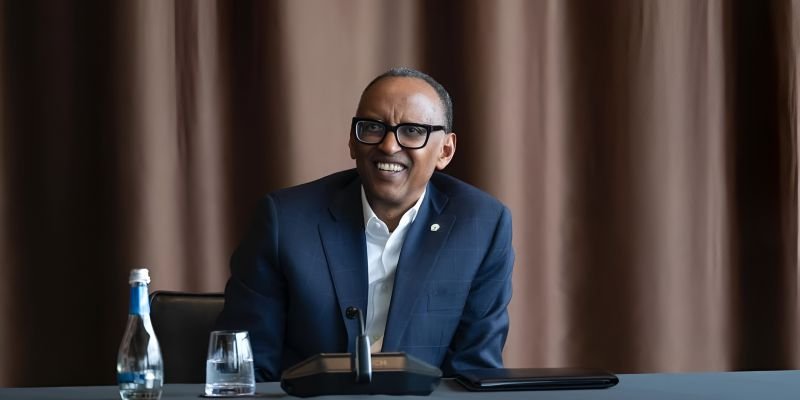
Kagame at a lectern is a different kind of presence from most of his counterparts. He does not perform warmth or reach for the easy reassurance of political language. He is precise, measured, and given to silences that feel deliberate rather than uncomfortable. When he speaks about Rwanda’s future, he speaks in the vocabulary of execution rather than aspiration, specific targets, specific timelines, specific accountability structures.
The military background surfaces less in tone than in architecture: the sense that decisions have already been mapped before the conversation begins, that the direction is set and what remains is the discipline to move in it.
People who work with him describe a leader who reads constantly, holds his advisors to standards of preparation that most governments do not require, and carries a very low tolerance, expressed quietly, without drama, for anything that functions as an excuse. The emphasis on self-reliance that runs through all of Kagame’s public statements is not rhetorical decoration.
It is the central feature of a governing philosophy that was shaped, in its deepest roots, by the experience of being a refugee in someone else’s country and returning to build on your own what no one else was going to build for you.
Rwanda cannot afford to wait, he has said, in various forms, across many years. It cannot wait for the slow consensus of systems that were built for countries with different histories and different starting points. It must build itself, relentlessly, with whatever it has, and measure its progress against its own capacity rather than against the expectations of those who observe from a comfortable distance.
This is a philosophy that is visible in everything from the performance contracts signed by district officials to the 4G expansion in rural hillside communities to the presence of Rwandan diplomats in rooms where African development policy is being decided. It is a philosophy that produces results. It is also a philosophy that concentrates authority in ways that the philosophy itself makes difficult to question.
What the Future Holds, and What It Asks
Rwanda’s GDP grew by 9.4 per cent in 2025. Paul Kagame is 67 years old and serving his fourth term in office. He is, constitutionally, eligible to serve two more. The country he has built over the past twenty-five years is measurably, verifiably different from the one he began with, and the case he makes for his methods rests, to a significant degree, on the reality of that difference.
The question that sits at the far end of all of this is the one that no growth figure can answer and no governance index can resolve: what does a country that has been built this tightly, this deliberately, and around the authority of one person and one party, do with itself when that person is no longer there to hold it together?
Strong institutions are the answer that Rwanda’s advocates offer, and the imihigo system and the anti-corruption architecture are real institutions. But institutions derive their strength partly from the culture of accountability that surrounds them, and that culture, in Rwanda, flows downward from a single, very particular source.
If the model succeeds fully, if the digital economy reaches its ambitions, if the health outcomes continue to improve, if the regional influence consolidates and Kigali becomes what its architects intend it to become, the world will have a genuinely important proof of concept for what determined, serious governance can produce in a post-conflict, resource-poor, landlocked African country. That proof of concept will matter enormously for every other country on the continent that is trying to make the same argument to the same sceptical world.
And if the architecture is too rigid to adapt, if the absence of friction turns out to have removed something essential, a corrective mechanism, a pressure valve, a way for inconvenient truths to surface before they become something larger, then the same tightness that made Rwanda move so fast could be the thing that makes it brittle when it needs to bend.
A traffic camera in Kigali captures a speeding motorbike and sends a fine to the driver’s phone within three minutes. The system works exactly as designed, efficiently, fairly, and with no room for negotiation. You can admire the precision completely and still find yourself wondering who decides what the system gets designed to do next, and what happens to the person who thinks the design could be improved and says so out loud.
That question will outlast any answer Kagame gives in his lifetime. Which means, in the end, it belongs to Rwanda.