
Every electric vehicle sold in Europe, every smartphone assembled in Shenzhen, every laptop delivered to a doorstep in California carries inside it a small, quiet piece of the Democratic Republic of Congo. The cobalt that makes lithium-ion batteries hold their charge, the coltan that stabilises the capacitors in almost every piece of consumer electronics on earth, these minerals do not appear out of thin air.
They come from the ground, overwhelmingly from one particular stretch of central African earth, extracted at enormous human cost and sold at prices set largely by people who have never set foot in the country.
The world has built its green energy future, its digital revolution, its entire vision of clean modernity, on the back of a country that produces more of this century’s most critical raw materials than anywhere else on the planet. And that country, the Democratic Republic of Congo, remains one of the poorest places on earth.
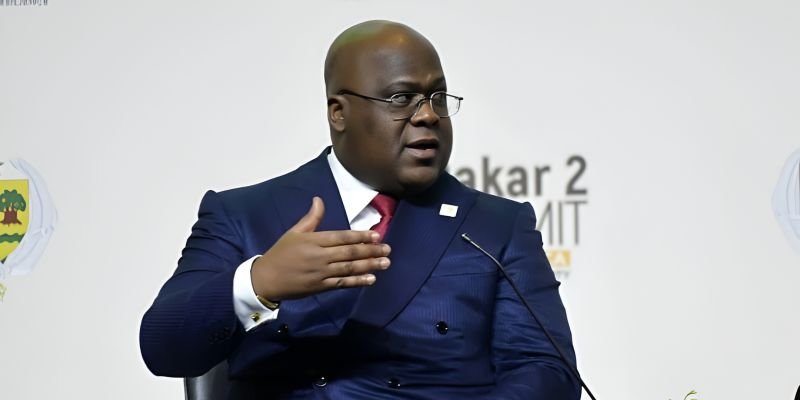
That contradiction, enormous, structural, and entirely deliberate, is the condition that Félix Tshisekedi inherited when he became the DRC’s fifth president in January 2019. It is the contradiction he has spent six years trying, with uneven results and under extraordinary pressure, to change. Whether he is succeeding is a question that depends entirely on what you are measuring, and who is doing the measuring.
The Son of a Dream
To understand what it meant when Félix Tshisekedi walked into the Palais de la Nation in January 2019 and was handed the Congolese flag and constitution by a departing Joseph Kabila, you have to understand what his surname means to an older generation of Congolese. His father, Étienne Tshisekedi, spent four decades as the public conscience of a country that rarely had one in its government.
He founded the Union for Democracy and Social Progress in 1982 as a direct act of defiance against Mobutu Sese Seko’s dictatorship, was imprisoned for it, was exiled to his ancestral village for it, and refused to be bought off or silenced throughout the years that followed. He ran for president three times and never won in circumstances that observers could accept as legitimate.
He died in Brussels in 2017, still fighting, and Kabila’s government refused to allow his body home. For two years, the great opposition leader of the DRC lay in a foreign mortuary while his country continued without him.
When Félix won, in elections that were themselves disputed, with credible allegations of a backroom arrangement between Tshisekedi and the outgoing Kabila, and with the Catholic Church’s observer mission concluding that Fayulu had actually received the most votes, the Congolese who were willing to accept the result did so at least partly because the name Tshisekedi carried a promise. The son of the man who had held out for decades was now, finally, in the building.
He called on the troubled nation to engage in a new battle, one for the well-being of each citizen. He announced the release of political prisoners. He called his father “president” in his inaugural address, to wild cheers from the crowd. The new president declared that Congo would not be a nation of division, hate or tribalism.
It was an extraordinary moment, the first peaceful transfer of power in the history of the DRC, after nearly six decades of independence that had produced dictatorship, two catastrophic regional wars, and governance so predatory that it had become the template for what political scientists mean when they use the phrase “failed state.”
The problem was that Kabila had left the building but kept the keys. His coalition dominated parliament. His loyalists sat throughout the judiciary, the military, and the security services. Tshisekedi was president in constitutional terms; in practical terms, he was governing a country that his predecessor still largely controlled.
Observers expected him to be managed. Instead, he spent the first years of his term in a slow, careful consolidation, building his own base, pulling loyalty away from Kabila’s network, and waiting for the moment when he could govern rather than simply occupy the title of governing.
By December 2023, that moment had arrived decisively enough. Re-elected with over 73% of the vote, Tshisekedi reaffirmed commitments to economic reform, anti-corruption measures, and infrastructure development.
His critics argued the election was managed rather than free, that competition was constrained and the result was less a mandate than a consolidation. His supporters argued it was the first time a Congolese president had won a second term without tanks in the street, and that this itself represented progress.
Both things were true, in the way that most true things about Congo are true, partial, complicated, and carrying the weight of a history that makes straightforward judgement almost impossible.
What the Ground Holds
The Kolwezi basin in Katanga province in the south-east of the country holds an estimated 71% of the world’s proven cobalt reserves. The number is worth sitting with. Nearly three quarters of the entire planet’s supply of one of the most critical minerals in the global energy transition lies in one place, in one country, administered by a government whose relationship to the companies extracting it has historically resembled that of a landowner who has been persuaded, under duress, to accept a fraction of what the land is worth.
Coltan, used in the capacitors of virtually every device with a circuit board, comes overwhelmingly from eastern Congo. Copper, lithium, uranium, gold, tin, tungsten, the mineral geography of the DRC reads like a list of everything the modern economy requires to function, concentrated in an area roughly the size of western Europe. Exports of copper and cobalt are equivalent to about 40% of Congo’s GDP. The country produces wealth at a scale that its people have almost never directly experienced.
Most African producers remain confined to the lowest-value end of the supply chain, exporting raw ore while refining, manufacturing and profit accumulation take place elsewhere.
In Congo’s case, this structure was built over decades of foreign extraction, Belgian colonial exploitation followed by Mobutu’s kleptocracy, followed by a succession of governance arrangements that prioritised access to minerals over the question of who the minerals were actually for.
Chinese companies, which moved aggressively into Congolese mining in the early 2000s, now dominate the processing and export of the country’s cobalt. The value of trade between the two countries stood at almost $27 billion in 2024, while Congo’s trade with the US was just $820 million over the same period.
This is the system that Tshisekedi, in his second term, has begun to push back against with a seriousness and a degree of economic leverage that Congo has rarely had. In February 2025, with cobalt prices at a nine-year low and Chinese-controlled refiners capturing most of the value from Congolese ore, the DRC halted all exports of the mineral essential to AI, weaponry, and electric vehicles. Prices surged. Kinshasa kept the tap closed for eight months.
When exports resumed in mid-October, they came with quotas: 18,125 metric tons for the rest of 2025, then 96,600 metric tons annually for 2026 and 2027, less than half the DRC’s 2024 output. The move was the most ambitious assertion of mineral sovereignty by any African country in decades.
It was also a gamble, because the threat that battery manufacturers would accelerate the shift toward cobalt-free chemistries was real, and the cost of alienating Chinese companies that still dominate production was significant. The government viewed the restrictions as a real lever for Congo to influence the strategic market, increase revenues, and improve the living conditions of its population.
Beyond the export ban, Tshisekedi launched the E-Trace digital platform, a traceability system that tracks minerals from the mine face to the export gate, designed to curb the artisanal mining sector’s entanglement with conflict and smuggling.
He renegotiated the terms of the Sicomines infrastructure-for-minerals deal with China, securing additional road financing and royalties for the state mining company Gécamines that the original contract, signed under Kabila, had largely denied.
He endorsed an agreement with KoBold Metals, backed by some of the largest names in American technology investment, to explore Manono, a world-class lithium deposit, positioning Congo as a partner in the American effort to build supply chains outside Chinese control. And he used the cobalt ban as a bargaining chip in the most pressing crisis of his presidency: the war in the east.
What the War Costs
Two thousand six hundred kilometres separate Kinshasa from Goma, the capital of North Kivu province in eastern Congo. The distance is not merely geographical. It is administrative, cultural, and, in the most consequential sense, political.
The east has been a different country for most of the past thirty years, contested by dozens of armed groups, exploited for its extraordinary mineral wealth, and largely administered by whoever had the most soldiers and the least reluctance to use them.
On 27 January 2025, Rwandan-backed M23 rebels entered the city of Goma, unleashing an attack that resulted in civilian casualties, sexual violence, and widespread looting. Home to two million residents, Goma became a city of chaos and devastation.
The fighting had already caused people in at least nine displacement sites around Goma to flee toward the city. The UNHCR reported that increased fighting had displaced 400,000 people in the preceding three weeks, adding to more than four million already displaced in dire conditions in eastern Congo.
The scale of what followed was staggering even by the standards of a region that has sustained catastrophe for decades. Over 1.1 million individuals were displaced across the North and South Kivu provinces due to the M23 advance, of whom 660,513 had been re-displaced from pre-existing sites and collective centres in and around Goma. Hospitals were overwhelmed.
The banking system shut down when Kinshasa withdrew from the occupied city. Schools became shelters. Most displaced people who returned home described scenes of ruin: homes reduced to rubble, schools and clinics damaged by artillery fire, farmland scattered with unexploded bombs, and a local economy crippled by closed banks and scarce cash.
Tshisekedi called it what multiple UN reports and international bodies had concluded it was: an invasion, underwritten by Rwanda. On 18 January 2025, he reaffirmed Kinshasa’s refusal to engage in dialogue with the M23 rebels, stating, “Legitimizing these criminals would be an insult to the victims and to international law.”
He severed diplomatic ties with Rwanda. He called for national mobilisation. None of it stopped the advance, because the advance was backed by a regional military power with its own strategic interest in eastern Congo’s mineral wealth, and Congo’s national army, fragmented, under-equipped, and assembled over decades from integrated rebel groups and Mobutu-era remnants, was inadequate to the task.
The mineral dimension of the conflict is direct rather than incidental. The eastern territories that M23 and Rwanda control contain substantial deposits of gold, tin, tantalum, and coltan. A UN expert report stated that around 120 tonnes of coltan were being smuggled into Rwanda every month, and pointed to a sharp rise in Rwanda’s mineral exports, much of which is suspected to originate from the DRC.
The European Union had agreed to provide Rwanda with approximately $935 million in exchange for minerals including tin, tungsten, and gold, minerals whose origins, in some cases, passed through territory where their provenance could not be clearly established.
This is the loop that the conflict runs through: Congo’s minerals fund the world’s technology economy; the world’s technology economy creates demand that makes Congo’s minerals worth fighting for; the fight for Congo’s minerals displaces millions of its people and prevents the investment in governance and infrastructure that might allow the country to capture more value from what it produces; and so the cycle continues, with the costs borne almost entirely by people who have no seat at any of the tables where the decisions are made.
The Minerals-for-Peace Equation
Tshisekedi saw the leverage and decided to use it. In February 2025, as M23 forces held Goma and the humanitarian situation deepened, he wrote to Donald Trump offering American companies preferential access to Congo’s critical minerals in exchange for security assistance.
The Washington Accords followed in June 2025, brokering peace between the DRC and Rwanda under US mediation and paving the way for bilateral strategic partnership agreements that granted American companies preferential access to Congolese minerals. By December 2025, the arrangement was formalised at a signing ceremony where Trump declared that everybody was going to make a lot of money.
The diplomacy was real and it produced a peace agreement, which mattered enormously to the people in eastern Congo who had been living in conditions that organisations like Médecins Sans Frontières were struggling to describe with language that felt adequate. But the terms of that peace deserve scrutiny.
There is no clear mechanism ensuring that the DRC’s state mining company, Gécamines, or the Congolese treasury, benefits directly from these new arrangements. Mineral deals struck under the pressure of active conflict, with the country’s sovereign territory occupied and its civilian population displaced by millions, are rarely structured in favour of the party that owns the ground.
Tshisekedi was aware of this and said so. He stated that Congo would not auction its mineral resources to the United States. He maintained that the existing strategic partnership with China remained in place and that negotiations with the Americans were ongoing on terms that Congo, as the owner of the resources, would determine.
Whether that position can be sustained when the country simultaneously needs security assistance, economic investment, and diplomatic support from the same parties it is trying to negotiate against on mineral terms is an open question, and it is the central tension of his second term.
He is, simultaneously, trying to claim sovereignty over what Congo produces and remain attractive enough to the powers that want it that they continue to engage. He is trying to capture more value from Congolese minerals while navigating the genuine risk that pushing too hard will accelerate the development of cobalt-free battery technologies and eliminate the leverage he is trying to exercise.
He is trying to build stable governance in a country whose east is partly controlled by a rebel movement backed by a neighbouring state, and do so without either capitulating to that movement or escalating the conflict to a point that produces catastrophe at a scale beyond what the humanitarian system can absorb. These are not separate problems. They are the same problem, with different faces.
What Gets Built, and for Whom
Tshisekedi’s ambitions for Congo’s domestic development are genuine and, in places, beginning to materialise. The Kivu-Kinshasa Green Corridor, launched in 2025, is designed to connect the mineral-rich east to the capital with infrastructure that creates jobs and supports agricultural supply chains alongside logistics networks, a recognition that the economic case for the east should, eventually, be something other than the case for extracting whatever the ground contains.
The Special Economic Zones that Tshisekedi mandated in 2023 are intended to build domestic processing capacity so that Congo stops shipping raw ore and begins, over time, to refine minerals into higher-value materials before they leave the country.
FDI inflows into Congo have shown resilience, with a notable increase to $1.67 billion in 2023, an 18% rise from the previous year, and the country attracted $130.7 million in exploration investments in 2024, the highest in Africa. The numbers reflect genuine interest from the global business community in a country that has suddenly become impossible to ignore for anyone building a supply chain in batteries, defence, aerospace, or electronics.
Whether that investment reaches the people who live near the mines, or in the towns that have been depopulated by conflict, or in the villages where artisanal miners work without safety equipment for wages that bear no relationship to the value of what they pull from the earth, that is where the ambition meets the structural reality.
The artisanal mining sector alone provides a livelihood to an estimated 250,000 people in the DRC. Most of them have no legal protection, no health insurance, no recourse when accidents happen, and no share in the profits generated when the ore they dig reaches a battery factory in South Korea or a defence contractor in Virginia.
Tshisekedi has said the right things about this, about local processing, about renegotiating contracts, about the vision of what his father’s generation would have called economic sovereignty. The distance between those words and the conditions in which most Congolese actually live remains vast. His government has made some progress in closing it. The structural forces working to keep it open are considerably larger than any one government’s capacity to overcome.
The Country Larger Than the Man
There is a version of Félix Tshisekedi’s story that is a story of a man rising to the occasion, a leader who inherited a country in its worst possible condition, who managed a succession that could have been violent and was not, who navigated the power of his predecessor, consolidated democratic legitimacy in a second election, and then used the leverage of Congo’s mineral wealth to begin rewriting the terms of the country’s relationship with the global economy. That version is supported by evidence.
There is another version that holds that the systemic forces shaping Congo, the colonial extraction model that Belgium perfected and foreign companies perpetuated, the Cold War patronage that sustained Mobutu, the regional conflicts that have made eastern Congo permanently unstable, the institutional weakness that decades of kleptocracy produced, are larger than any individual’s ability to change, and that a president trying to move within that system will inevitably reproduce more of it than he manages to transform. That version is also supported by evidence.
The most honest reading of where Tshisekedi’s presidency stands is somewhere between those versions, which is to say: genuinely in progress, genuinely constrained, and genuinely uncertain. He is a leader trying to reclaim national wealth in a system that was built to export it. He is trying to establish peace in a region where neighbouring states have direct financial incentives to perpetuate instability.
He is trying to build institutions in a country whose institutional history has been one of their systematic dismantling. And he is doing all of this while managing the expectations of eighty million people who have been told, in some form, for sixty years, that their country’s extraordinary richness is about to begin serving them.
Return to Kolwezi
The women who carry cobalt ore on their backs in the Kolwezi basin have a name for what they do. It is called creusage, digging, and it has been done in these hills for longer than most of the companies that buy the ore have existed.
The price they receive for a sack of ore shifts with global markets they cannot see, driven by decisions made in board rooms they will never enter, by people building cars for consumers who will never know their names. The ore they dig will end up in a battery that sits inside a vehicle purchased in a country where the average annual income is more than fifty times their own.
That distance, between what Congo produces and what Congo receives; between the world’s dependence on Congolese minerals and the world’s indifference to Congolese lives, is the central problem of Félix Tshisekedi’s presidency. It is also a problem that predates him by over a century, and that will very likely outlast him unless something structural changes in the relationship between the countries that extract and the countries that refine.
He is trying. The cobalt ban, the renegotiated contracts, the Washington Accords, the green corridor, the push for local processing, these are real attempts to change a relationship that has never, in Congo’s post-colonial history, changed to Congo’s advantage. Whether they succeed depends on things that are partly within a president’s control and partly determined by the appetites of much larger powers.
In Kolwezi, the women still carry the ore. The price has risen since the export ban was lifted. Some of that money will reach the treasury in Kinshasa. How much of it will reach Kolwezi is a question that Congo has been asking since 1960, and that has yet, in any meaningful way, to be answered.
The ground is unchanged. The question of who it serves is the only thing worth watching now.