
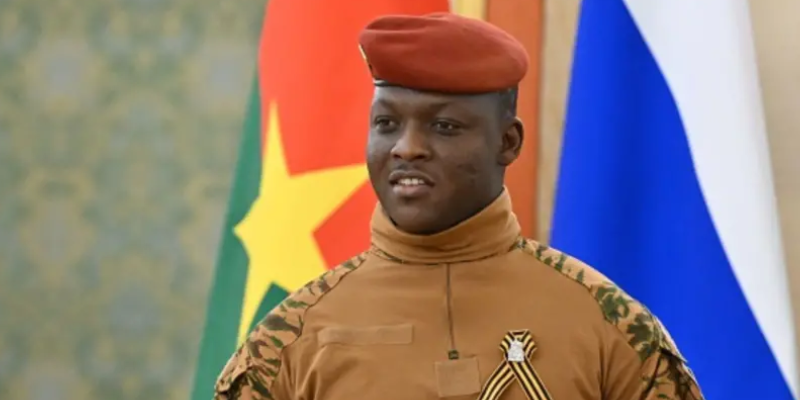
When Captain Ibrahim Traoré seized power at 34, overthrowing Interim President Paul-Henri Sandaogo Damiba, Burkina Faso gained a leader who instantly became a symbol. He stepped onto the world stage as the youngest head of state, carrying a profile that reminded many of Thomas Sankara, Burkina Faso’s legendary former president who rose to leadership at a similarly young age.
From the beginning, Traoré was never positioned as a transitional figure. His ascent marked a deeper shift across the Sahel, where military takeovers had already become a defining pattern since around 2020. Across several countries, coups were justified through familiar promises: national reset, improved security, and a future return to civilian rule.
Years later, democratic restoration remains distant. Instead, the region has seen a new bloc emerge, built on radical political messaging, pan-Africanist symbolism, and a strong rejection of Western influence, especially France. Traoré has become the central personality driving this shift, and increasingly, the face of a new political order in the Sahel.
From National Leader to Regional Anchor
Traoré’s influence extends beyond Burkina Faso’s borders. He has positioned himself as a key figure within the Alliance of Sahelian States, a grouping that has taken on a clear ideological identity: anti-French, anti-ECOWAS, Marxist-leaning in tone, and rooted in a fiercely nationalist view of sovereignty.
Within this alliance, Traoré has emerged as the de facto leader, a role strengthened by his visibility, sharp political messaging, and direct appeals to a population hungry for leaders who project strength.
His rise reflects a broader reality across West Africa: authority today is shaped as much by narrative and symbolism as by formal structures. Traoré has understood this from day one and built his public brand accordingly.
France’s Retreat and the Collapse of Old Influence
For decades, France held significant military influence across the Sahel. That era has been rapidly eroding, and Traoré has become one of the loudest drivers of this shift.
Public anger toward France grew steadily across the region, fuelled by perceptions of interference, failed security outcomes, and a lingering colonial shadow. Under pressure from leaders like Traoré, France’s position weakened further. Earlier this year, France handed over its last remaining military bases in the Sahel to Senegalese local authorities, closing a chapter that once defined regional security arrangements.
This shift has rebalanced geopolitical influence in the region. It has also introduced new uncertainty, as alternative partnerships rise and traditional security structures fall away.
Traoré has gained popular credit for forcing this reset, strengthening his image as a leader willing to confront global powers in defence of national pride.
Why the Sahel’s Youth Have Elevated Him
The Sahel has one of the youngest populations in the world, and its youth carry the heaviest burden of economic hardship. Poverty, unemployment, entrenched corruption, and growing insecurity have created a relentless pressure on daily life. Meanwhile, the threat posed by jihadist groups continues to destabilise communities and weaken confidence in the state.
Into that frustration stepped Traoré: young, charismatic, military-trained, and visibly defiant toward Western powers. For many, he became the leader who looked like them and spoke like someone who understood their anger.
His popularity has often taken on a cult-like intensity. He is celebrated as proof that a new generation can seize control of national destiny. His leadership has turned into a symbol of resistance, even among those who remain cautious about military rule.
In a region where many feel unheard, symbolism can become power.
Controlling Gold, Nationalising Assets, Redrawing the Economic Map
Traoré has also moved aggressively on economic sovereignty, focusing on the country’s gold sector and wider resource control.
In 2023, Burkina Faso established its first gold refinery, a milestone that aligned with a deeper goal: keeping more value inside the country rather than exporting raw wealth outward. Gold has long been a cornerstone of Burkina Faso’s economy, and the refinery signalled a shift toward local processing and stronger control over the supply chain.
In 2025, Traoré announced a series of nationalisations affecting foreign-owned companies in mining and industrial sectors. He also backed the creation of a government-run mining company, strengthening state control over strategic resources.
These moves have been welcomed by many young citizens as a long-overdue economic correction. The message is simple and highly effective: Burkina Faso will own more of what it produces.
For markets and foreign investors, the picture is more complex. Nationalisation policies can signal a new era of state power, yet they also increase uncertainty around investor protections, long-term operating stability, and governance transparency.
Traoré’s economic agenda has therefore become both a rallying point at home and a recalibration event abroad.
Rising Authority, Shrinking Political Space
As Traoré expands control over resources and strengthens his regional position, his government has also tightened the internal political environment.
Press freedom has come under heavy pressure, with restrictions that include the banning of France 24. Opposition politics have faced intensified suppression, signalling a government that prioritises authority and stability over open political competition.
This dynamic has become central to how Traoré is assessed: he is building legitimacy through nationalist economics and security messaging, while reducing space for dissent.
Such a combination often produces short-term consolidation, yet it also increases long-term risk. When institutions narrow, criticism moves underground. When debate disappears, instability can return through shock events rather than negotiation.
A Coup Attempt Claim and a Regional Tension Flashpoint
In April this year, the government announced that it had prevented a planned coup attempt. Authorities accused Côte d’Ivoire of backing the alleged plot, adding another layer of tension to an already fragile regional landscape.
The announcement reinforced the perception that Traoré’s leadership remains contested and vulnerable to internal conflict. It also highlighted how quickly Sahel politics can spill beyond borders, escalating mistrust between neighbouring states.
For regional trade, security cooperation, and diplomatic stability, such accusations carry direct economic consequences. Investors watch political continuity. Governments watch alignment. Populations watch for signs of fracture.
Brand, Optics, and the Politics of Performance
One of Traoré’s greatest strengths is also one of his most controversial tools: image control.
Nigerian journalist Azubuike Ishiekwene observed that Traoré presents himself as a new face of African renaissance. His public persona is carefully constructed, from stylish military fatigues to matching scarves, berets, and boots, paired with speeches targeting Western imperialism and colonialism.
This is political branding at full power.
Traoré understands that modern influence is built through optics as much as governance. His image communicates discipline, defiance, and identity. For many supporters, it feels like pride restored. For critics, it looks like authoritarian theatre.
Either way, it works.
A Stormy Petrel With Real Momentum
Ibrahim Traoré remains one of the most disruptive figures in West African politics. He has captured youth imagination, pressured old power structures, and reshaped Burkina Faso’s economic direction through resource nationalism and state control.
He has also presided over a narrowing political environment, rising censorship, and growing concerns around democratic timelines.
His leadership sits at the centre of a major regional transformation, where sovereignty, alliances, and economic ownership are being renegotiated in real time.
Traoré is more than a president. He is a signal of a wider Sahel moment: impatient, proud, volatile, and determined to rewrite the rules.
Whether that rewrite produces lasting prosperity or deeper instability will depend on what comes next: security outcomes, economic management, and the ability to build institutions that outlive a single leader.