
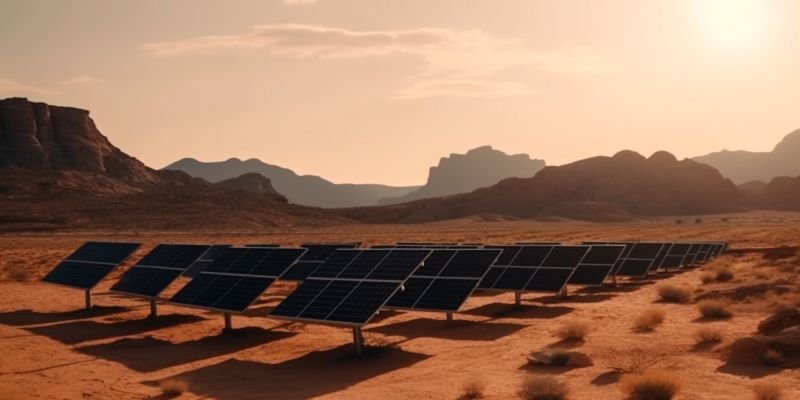
The Brutal Reality of Energy in Africa’s Most Fragile Regions
In the clean, air-conditioned offices of London or D.C., solar power is a “solution.” It’s a line item in an ESG report. But in the Sahel or the eastern DRC, solar isn’t a “solution,” it’s a target. Or a lifeline. Or a liability. It depends entirely on who has the most guns that week.
The big irony of renewable energy is that it’s supposed to be decentralized and “freeing.” But the truth is, energy infrastructure is only as stable as the ground it’s bolted into. If the ground is moving because of a coup or a militia advance, that “clean energy future” becomes a pile of expensive, broken glass real fast.
1. The Security Tax: Why “Free” Sunlight is So Expensive
We talk about the “levelized cost of energy,” but nobody talks about the “Militia Tax.” When you build a solar farm in a stable country, your biggest headache is local zoning laws. In Mali or the Congo, your biggest headache is making sure your lead engineer doesn’t get kidnapped or your lithium batteries don’t end up on the black market in a different country.
The Physical Problem
Solar panels are big. They’re shiny. They’re obvious. You can’t hide a 20-megawatt farm. In a conflict zone, that makes you a magnet for:
- Looting: High-quality glass and copper wiring are basically currency.
- Sabotage: If a rebel group wants to punish a city for supporting the government, they don’t have to storm the city, they just have to break the panels.
- Extortion: “Nice solar farm you got here. It would be a shame if something happened to it.” This is the reality developers face every day.
2. Mali: Where Policy Goes to Die
Mali is heartbreaking because the potential is staggering. The sun there is relentless. It should be the solar capital of the world. Instead, it’s a graveyard of half-finished projects and “stalled” funding.
The Coup Cycle
Since 2020, Mali has been in a geopolitical blender. Every time a new group takes power, the international community (the people with the money) freaks out and pulls the plug.
Imagine you’re a developer. You’ve spent three years doing the paperwork, environmental studies, and local hiring. You’re weeks away from breaking ground. Then, the news hits: another coup. The World Bank freezes the accounts. Your insurance provider cancels your policy.
That’s not a “policy challenge.” That’s a career-killer.
The Shift to “Transactional” Power
Because Western money comes with strings attached (human rights, transparency, stability), the Malian government is looking elsewhere. They’re making deals with anyone who doesn’t ask questions. This might get the panels installed faster, but it creates a “wild west” environment. Without long-term maintenance contracts or local buy-in, these projects often fall apart the moment the initial contractor leaves.
3. The Congo: Building in the “Grey Zone”
If Mali is about political instability, the DRC is about pure, physical chaos. But strangely, this is where we see the most “human” resilience.
The Nuru Story
Look at what companies like Nuru are doing in Goma. They aren’t just building power plants; they’re building fortresses of hope. They operate in cities that are effectively surrounded by rebel groups like the M23.
How do they keep the lights on?
They don’t rely on the government. They rely on the people.
- The Social Contract: If the solar grid powers the hospital where your kid was born and the pump that brings water to your street, you’re going to protect it. You become the security guard.
- Diesel vs. Solar: When a war blocks the roads, diesel trucks can’t get through. Prices 10x overnight. But the sun doesn’t care about road blocks. In a siege, solar is the only thing that works.
4. The “Fragility Premium”
Investing in a solar project in a “fragile state” is like playing poker with a deck where the cards keep changing.
| The Cost of Doing Business | Stable Region | Conflict Zone |
| Security | A gate and a camera. | Armed guards and “community payments.” |
| Insurance | Standard. | “Political Violence” premiums that eat your profit. |
| Logistics | Trucks on highways. | Military escorts and bribes at checkpoints. |
The “Fragility Premium” is not just a number on a spreadsheet. It’s the reason why a project that costs $10 million in Senegal costs $25 million in the DRC.
5. Can We Fix This? (The Realist’s Take)
There’s no magic wand. You can’t “solve” political instability with a better battery. But there is a way forward that isn’t just wishful thinking.
- Stop Building “Mega-Farms”: Big targets get hit. Modular, containerized mini-grids that can be moved or hidden are the future of conflict-zone energy.
- Radical Localism: If the locals don’t own a piece of the project, they won’t defend it. Period.
- Risk Insurance that Actually Works: We need global funds that don’t run away the second things get “complicated.” Conflict is where the energy is needed most.
West Africa Solar Risk Matrix (March 2026)
| Risk Category | Sahel Juntas (Mali, Niger, Burkina Faso) | The Growth Giants (Nigeria, Ghana) | The Frontier Reformers (Benin, Senegal) | Regional Impact (L-H) |
| Political Stability | Critical: High risk of coup-related force majeure and regime-pivot away from Western DFIs. | Moderate: Civil unrest linked to inflation; policy consistency after 2025/26 reforms. | Low-Medium: Generally stable transitions, though youth-led “Gen-Z” protests remain a wildcard. | High |
| Currency & FX | High: Risk of exit from CFA Franc; liquidity freezes; limited hard-currency access. | Medium-High: Volatile Naira/Cedi exchange rates; shift toward USD-indexed PPAs. | Low: CFA stability provides a “safety floor,” but inflation pressure is rising. | High |
| Physical Security | Critical: Active insurgency targets infrastructure; high “Militia Tax” on logistics. | Medium-High: Bandits in Northern Nigeria; piracy risks affecting coastal equipment ports. | Low-Medium: Spillover risks from Sahel borders; minimal direct targeting of solar. | Medium |
| Regulatory Risk | High: Resource nationalism; “Sovereignty” laws favoring state-led projects over IPPs. | Medium: Complex bureaucracy but moving toward decentralization (e.g., Nigerian State Electricity Acts). | Low: Clearer mini-grid frameworks and investment codes (Benin’s 12-locality mini-grid model). | Medium |
Strategic Investor Playbook for 2026
1. The “Social Fence” vs. The Barbed Wire
In the DRC and Mali, traditional security is a sunken cost. The most resilient projects are those where the community holds equity.
- Mechanism: Allocate 5-10% of project revenue to local social infrastructure (schools/hospitals).
- Result: The community becomes the primary security force, protecting assets during riots or rebel advances.
2. The Rise of “Hard-Currency” Indexing
As of 2026, the era of pure local-currency Power Purchase Agreements (PPAs) is ending for large-scale solar.
- The Trend: Investors are successfully negotiating “Natural Hedging,” pegging PPA rates to the USD or Euro, or integrating solar into mining/industrial export zones where revenue is already in hard currency.
3. Agentic AI: The 2,000-Mile Repair Kit
Maintenance is no longer just a human logistical problem.
- Autonomous O&M: Using Agentic AI to manage remote sites. These systems don’t just alert you to a fault; they autonomously re-route power to bypass damaged panels during a conflict event.
- Drone Logistics: AI-managed drone swarms are now being used for thermal inspections and light delivery of spare parts in “No-Go Zones” where human convoys are at risk.
Key 2026 Trend: “Sovereignty” Deals
We are seeing a massive shift toward Interest-Driven Competition. Mali and Niger are increasingly looking toward BRICS-backed financing and non-traditional security-energy packages.
“Investor Tip: If you are a Western investor, your best bet is Blended Finance. Partner with Multilateral Investment Guarantee Agencies (MIGA) to secure Political Risk Insurance (PRI) before a single panel is bolted down.”
The Bottom Line
Energy infrastructure is only as stable as the region around it, but stability is often impossible without energy infrastructure. This is the great “Solar Paradox” of 2026.
In Mali and the Congo, solar power is no longer just a “green alternative”; it is a tool of survival. It won’t bring peace on its own, but by decentralizing power, literally and figuratively, it prevents a single coup or a single militia from plunging an entire nation into the dark.
The future of African solar is not found in the massive, shiny arrays of the Sahara; it’s found in the small, resilient, and community-guarded grids that refuse to turn off, even when the rest of the world has looked away.