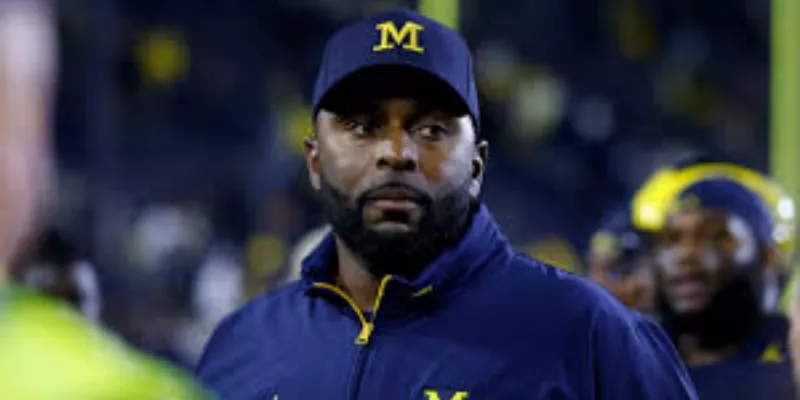
Who is Sherrone Moore?
Sherrone Banfield Moore came to this world on February 3, 1986, in Derby, Kansas. His upbringing was characterized by strong discipline and a solid work ethic which were influenced among other things by his parents’ attitude towards life as they were people of structure and perseverance.
After getting out of Derby High School in 2004, Sherrone Moore decided to take his football to the next level and enrolled at Butler County Community College. At the same time, he was attending the community college he played two seasons of junior college football as a guard and was named all-conference in which he was a standout performer.
Later, he transferred to the University of Oklahoma. At Oklahoma, Sherrone Moore played as an offensive guard and was part of Big 12 championship teams in 2006 and 2007, though he did not start every game. He earned his bachelor’s degree in communications from Oklahoma in 2008.
His time as a player exposed him to high-level competition and helped form the foundation for his future coaching career.
Transition to Coaching
After his playing career was over, Sherrone Moore decided to coach. In 2009 he started working at the University of Louisville as a graduate assistant. During his three years at Louisville, he was an assistant under head coaches Steve Kragthorpe and Charlie Strong and he was eventually promoted to tight ends coach of the team. While he was coaching, he also got a master’s degree in sports administration from the university.
In 2014, Sherrone Moore went to work at Central Michigan University. As tight ends coach, he initially was and then as assistant head coach and recruiting coordinator, he also took on the additional roles. He didn’t stop there as he kept on developing his character and coaching skills which eventually led him to become able to work at bigger programs.
Overview of the Sherrone Moore contract Story
The story of Sherrone Moore’s ascendancy and rapid plummet as head coach of the University of Michigan football team has been the main theme in recent sports news. He was once a figure surrounded by a lot of money, with a bright future in front of him, but his time ended quite suddenly in the first week of December 2025 after the school reported finding evidence of an inappropriate relationship with a staff member.
His dismissal prompts questions about the monetary details of his contract, how much he was paid, and whether he is going to receive the large buyout that was a part of his deal. This has also fueled searches about Sherrone Moore suspension and Sherrone Moore detained following the fallout.
Sherrone Moore’s pay, besides the scandal, is a clear indication of how college football coaching positions have turned into profitable roles, especially at elite programs like Michigan. Many readers are also searching for Sherrone Moore salary in connection with the developing story and the Michigan football scandal.
Moore’s Salary at Michigan
Michigan coach contract details
As head coach, Sherrone Moore’s pay was quite significant. His base salary, as per various news reports and official records, was approximately 6.11 million U.S. dollars yearly. With that salary, he was one of the 40 highest-paid college football coaches in the United States. The local police department is still receiving lots of calls about the Sherrone Moore arrest report as the stories about the Michigan football coaching change 2025 are getting more and more popular in the area.
That salary reflects only the base pay outlined in his contract. In addition to base pay, coaches at this level typically receive incentive bonuses tied to team performance. Sources indicate his contract included potential bonus money tied to conference championships, national titles, and other achievements. In some years he could have earned an additional USD 3.5 million in bonuses if certain goals were met, including half million dollar bonuses for conference success or even USD 1 million for a national championship.
Taken together, Sherrone Moore’s total annual compensation was structured to grow significantly if the team performed well. This kind of incentive structure is common among elite coaching contracts and often becomes a point of debate in a Michigan coach investigation.
What Moore Stood to Earn Over Time
Sherrone Moore buyout
Sherrone Moore’s contract was arranged in a way to maintain both his position and give him financial reward. Reports indicate the agreement he signed stretched five years, with salary and other compensation scheduled through the 2029 season. His salary would remain high every year he was in the post, and retention bonuses would be there to add more over the base pay.
The contract provided for a retention bonus of USD 500,000 per season if he continued as head coach. So his real pay could rise considerably from year to year even in a season without performance bonuses. This setup was logical for a major program like Michigan. Institutions aim to reward stability and keep coaches who build competitive teams. The incentives were created for that purpose only and now drive interest in the why Sherrone Moore was fired at Michigan query online.
Sherrone Moore’s remaining years on the deal also raise the long running question of whether a Sherrone Moore buyout dispute will occur, especially since initial reports indicate termination for cause.
Conclusion
The Michigan story has become larger than a simple contract termination. The combination of compensation details, allegations, and legal uncertainty keeps the public focused on the Michigan football coach firing and the unresolved financial implications tied to the Sherrone Moore contract. As the university and Moore’s team move forward, the remaining tension centers on the potential Sherrone Moore buyout and how it will form the next chapter for Michigan football.