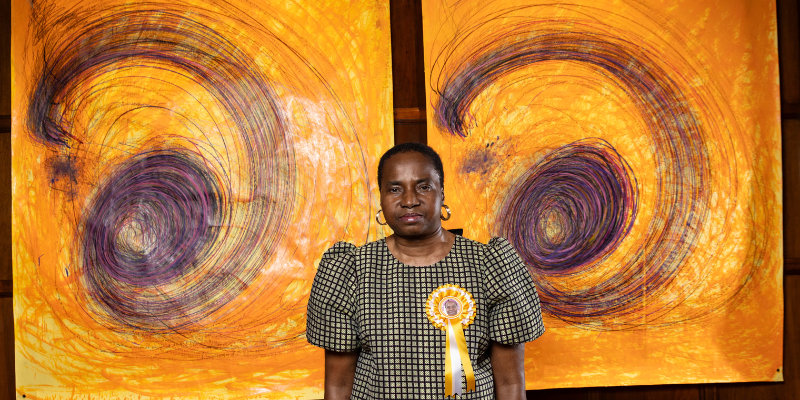
The 2025 Turner Prize delivered more than a headline. It delivered a shift in how the global art industry measures talent, influence, and long-term value. Nnena Kalu’s win stands as a landmark moment, placing a powerful spotlight on an artist whose work has been quietly building strength through discipline, originality, and a bold creative language.
Kalu becomes the first artist with learning difficulties to win the Turner Prize, one of the most respected honors in contemporary art. For the business of art, this matters on multiple levels: market recognition, institutional confidence, collector attention, and cultural reach. When a prize of this scale makes a clear choice, the ripple effect travels fast from galleries and museums to buyers, curators, and emerging artists studying the future of creative success.
This win signals a broader evolution in the industry: excellence leads the conversation, and the definition of who gets to sit at the top table continues to expand.
An art practice built on transformation
Kalu’s work stands out instantly. She creates vivid, high-energy sculptures using discarded fabric and VHS tape. Materials often seen as waste become the foundation of something striking, large, and visually unforgettable. The result is a body of work that feels bold and alive, filled with color, texture, and movement.
From a professional lens, this approach carries a message that modern business leaders instantly understand: value can be created where others see excess. Kalu’s materials reflect an instinct that aligns with the principles of circular thinking and sustainable design. Yet her sculptures never lean on trends or messaging as a shortcut. The work carries its own authority.
In a market that rewards originality, Kalu delivers a signature style with clarity. That clarity strengthens her long-term positioning in the contemporary art world, where collectors and institutions seek artists who build a recognizable visual identity.
Why the Turner Prize jury backed her
Awards shape perception. Perception shapes value. That is the art market reality.
Alex Farquharson, chair of the Turner Prize jury, explained that Kalu’s selection came down to quality. He also acknowledged what her win represents for the wider industry: a shift in how artists are viewed across neurotypes, and a dissolving boundary that has shaped both history and contemporary culture.
In business terms, the Turner Prize decision sends a strong signal to the ecosystem. It tells decision-makers that innovation and impact come in many forms, and the industry benefits when it expands its lens. When a jury led by experienced voices chooses an artist like Kalu, it builds confidence for institutions, sponsors, and galleries to invest deeper.
It also raises the standard for representation. This win becomes proof that inclusion and excellence work together at the highest level.
The ecosystem behind the success
Great talent thrives when the right system supports it.
Kalu works from ActionSpace in Clapham, a charity that provides studio space and professional support for learning-disabled artists. Her story highlights an important business lesson: success rarely happens in isolation. Behind standout performance sits infrastructure, mentorship, operational consistency, and a belief in long-term development.
In many industries, this is the difference between potential and achievement. In the arts, the same principle applies. When organizations create pathways for artists to work, refine, and produce consistently, they strengthen the creative economy. Kalu’s studio environment reflects what happens when talent is backed by the right platform.
Her career also shows how charities and community-based institutions can shape global outcomes. Their work becomes part of the value chain, producing impact that flows into cultural capital and economic opportunity.
From Glasgow roots to global attention
Kalu was born in Glasgow to Nigerian parents and moved to London at a young age. Her journey carries the weight of multiple identities, cultures, and influences. That background becomes part of the story the world now pays attention to, and it adds depth to her global appeal.
The contemporary art market thrives on stories that connect across borders. A collector in London, Lagos, New York, or Paris seeks work that carries presence and meaning. Kalu’s rise introduces a narrative that resonates across both Western institutions and African creative communities.
Her success strengthens the visibility of diasporic talent and reinforces the reality that cultural influence moves in multiple directions. The future of art remains global, and Kalu’s recognition adds momentum to that truth.
Breaking bias, building belief
Charlotte Hollinshead, Kalu’s studio manager, delivered the winner’s speech on her behalf. She spoke about the discrimination Kalu has faced and expressed hope that the award helps clear away prejudice.
That statement carries weight, because the creative industry shapes culture, and culture shapes business behavior. When a major institution rewards talent that once struggled for fair access, it changes the belief system of the market.
For young artists with learning disabilities, Kalu’s win becomes permission to pursue ambition with seriousness. For organizations, it becomes a reason to invest in better accessibility, better support systems, and better opportunities. For collectors and curators, it becomes a chance to discover work that may have been overlooked by outdated structures.
This is how industries evolve: one decision becomes a blueprint for what comes next.
A business impact that stretches beyond Europe
Kalu’s influence continues to spread across the Western art world, and her impact is expected to reach Africa in a meaningful way. Her win opens conversations that go beyond awards: representation, access, investment, and visibility.
Africa’s creative economy has been building powerful momentum through contemporary art, design, fashion, music, and film. Kalu’s achievement adds fuel to that momentum by showing what global recognition can look like for artists connected to African heritage.
Her work also creates opportunity for partnerships across continents, including exhibitions, collaborations, cultural programs, and collector networks. With global attention comes the potential for greater market demand, stronger institutional relationships, and expanded representation across major art platforms.
A new standard for excellence
Nnena Kalu’s Turner Prize win marks a moment the industry will remember. It reinforces that world-class talent thrives through originality, courage, and consistent work. It also proves that the definition of leadership in art continues to expand.
For the business of contemporary culture, her achievement becomes a case study in long-term value creation: a unique creative signature, a strong support ecosystem, and global recognition that builds market confidence.
Kalu has already made history. Now she shapes what the next era of contemporary art will look like.