
Nnaemeka Ikegwuonu’s Solar Solution to Food Loss!
Food systems don’t collapse in dramatic ways. They weaken quietly, in the hours after harvest.
A crate of tomatoes begins the day firm and bright. By late afternoon, the edges soften. By the next morning, the value had already dropped. In many agricultural markets across Africa, this slow decline is built into the system. Farmers grow food successfully, yet lose a significant portion of it before it ever reaches a paying buyer. Not because demand is missing, but because time is.
This is where agriculture quietly breaks. Not in production, but in preservation. It is also where Nnaemeka Ikegwuonu chose to work.
The Invisible Half of Agriculture
For decades, the focus in African agriculture has leaned toward increasing yield. Better seeds, improved irrigation, access to fertilizers. These are important, but they address only one half of the equation.
The other half begins after harvest. Across Nigeria, smallholder farmers often operate without access to reliable cold storage. Traditional refrigeration depends on stable electricity, something many rural and peri-urban farming communities simply do not have. Diesel-powered alternatives exist, but they are expensive to run and maintain, placing them out of reach for most farmers.
The result is predictable. Fruits, vegetables, and other perishable goods spoil within days. In some cases, within hours. Farmers are forced to sell immediately, often at unfavorable prices, simply to avoid total loss.
It creates a system where effort does not translate into income. Ikegwuonu understood this not as a distant observer, but as someone who had spent years in direct conversation with farmers.
Listening Before Building
Before ColdHubs, there was radio. In his early twenties, Ikegwuonu founded the Smallholders Foundation, using radio as a tool to reach farmers with practical agricultural knowledge. The program wasn’t built on theory. It was built on interaction. Farmers called in, shared challenges, asked questions, and described their day-to-day realities.
Over time, a pattern became clear. Farmers were not asking for more land or even better seeds. They were asking how to stop losing what they had already grown.
Storage kept coming up. Again and again. This is where his thinking shifted. The problem was not simply agricultural. It was infrastructural. And it required a different kind of solution.
Building ColdHubs Around Constraint, Not Convenience
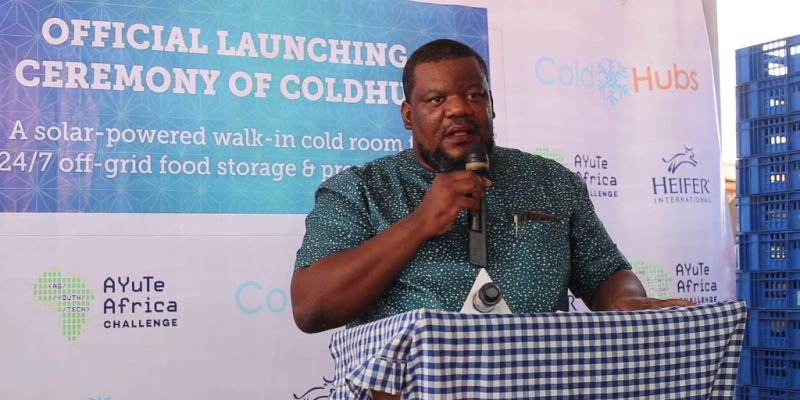
In 2015, Ikegwuonu founded ColdHubs, a company designed to address one specific gap in the food supply chain: the absence of reliable, accessible cold storage.
At its core, ColdHubs installs solar-powered walk-in cold rooms in markets and farm clusters, allowing farmers, traders, and wholesalers to store perishable goods close to where they operate.
The idea itself is not complicated. What makes it effective is how carefully it responds to real-world constraints.
The cold rooms run entirely on solar power, removing dependence on unreliable electricity grids. Energy generated during the day is stored in batteries, allowing the units to operate continuously, even at night.
More importantly, ColdHubs does not ask farmers to buy the technology.
It offers access instead. Farmers pay a small daily fee to store their produce, typically calculated per crate. This “pay-as-you-store” model removes the financial burden of ownership and aligns with the way smallholder farmers manage cash flow. It is a small shift in structure, but a significant shift in accessibility.
Extending Time, Restoring Control
The immediate impact of ColdHubs is measurable. Produce that would normally spoil within two days can remain fresh for up to three weeks when stored in these solar-powered units.
But the deeper impact is less visible and far more important. Time changes behavior.
When farmers are no longer forced to sell immediately after harvest, they gain control over when and how they enter the market. They can wait for better prices. They can avoid distress sales. They can reduce waste without sacrificing income. This changes the economics of smallholder farming in subtle but meaningful ways.
Income becomes less volatile. Losses become more manageable. Planning becomes possible. ColdHubs does not increase how much farmers grow. It protects what they already produce.
Beyond Storage: Building a Cold Chain
Cold storage, on its own, solves only part of the problem. Food can still spoil during transport. It can be damaged through poor handling. It can lose value before reaching urban markets.
ColdHubs has gradually expanded its model to address these gaps. The company now integrates temperature-controlled transportation, ensuring that produce remains fresh as it moves from farms to markets. It also provides durable plastic crates designed to reduce damage during handling and transit.
Alongside physical infrastructure, ColdHubs has introduced digital tools that allow users to track storage, manage logistics, and monitor produce in real time.
This layered approach reflects a broader understanding. A cold room is not a solution on its own. It is part of a system. And systems require continuity.
Technology That Stays in the Background
One of the more thoughtful aspects of ColdHubs is how it presents technology to its users. Farmers do not need to understand solar engineering or refrigeration systems. They interact with the service in simple, familiar terms. Store produce. Retrieve it later.
Behind the scenes, however, the system is carefully monitored. Each unit tracks temperature, battery performance, and operational efficiency through remote monitoring tools.
This balance is deliberate. Technology is powerful, but only when it does not overwhelm the user. ColdHubs keeps complexity hidden, allowing adoption to happen naturally.
Scaling With Context
Since its founding, ColdHubs has expanded across multiple states in Nigeria, operating dozens of cold rooms and serving thousands of farmers and traders.
Growth, however, has not come at the cost of context. Each unit is placed strategically, either in farming clusters where produce is harvested or in markets where it is sold. This ensures that the service fits into existing supply chains rather than attempting to replace them.
The company also invests in community engagement, training users on post-harvest handling and best practices to maximize the benefits of cold storage.
This attention to detail reflects a broader philosophy. Scale is not just about numbers. It is about relevance.
A Leadership Style Grounded in Observation
Ikegwuonu’s journey does not follow the typical narrative of technology entrepreneurship. He did not begin with a product. He began with a pattern.
Years of listening to farmers shaped his understanding of where the system was failing. ColdHubs emerged from that understanding, not from a desire to build technology for its own sake.
Even today, that approach remains visible. The company continues to evolve based on real-world feedback, refining its systems, expanding its services, and adapting to new challenges as they emerge. It is a form of leadership that prioritizes observation over assumption.
Redefining What Innovation Looks Like
There is a tendency to associate innovation with complexity. New technologies, advanced systems, large-scale disruption.
ColdHubs offers a quieter interpretation. It takes an existing concept, refrigeration, and rethinks how it is delivered. It adapts it to local conditions, removes barriers to access, and integrates it into everyday practice.
The result is not dramatic in appearance. But it is transformative in effect.
By focusing on the overlooked stage of the agricultural value chain, the period after harvest, ColdHubs shifts the conversation around food systems. It suggests that improving production is only part of the story. Preserving production is equally critical.
The Work That Continues
The challenge ColdHubs addresses is far from resolved. Across Africa, millions of smallholder farmers still operate without access to reliable cold storage. Post-harvest losses remain high. Infrastructure gaps persist.
ColdHubs continues to expand, with plans to extend its model into other regions facing similar challenges. The ambition is clear, but it is grounded in a familiar principle. Solve the problem where it exists. Build with what is available. Scale without losing sight of context.
Closing Perspective
Food waste is often framed as a global issue, measured in statistics and percentages. But on the ground, it is personal.
It is the farmer who watches part of their harvest lose value overnight. It is the trader who cannot hold inventory long enough to secure a better price. It is the system that quietly accepts loss as inevitable. Nnaemeka Ikegwuonu chose not to accept it.
Through ColdHubs, he did not try to reinvent agriculture. He focused on one fragile moment within it and strengthened it. Sometimes, that is enough to change everything.