
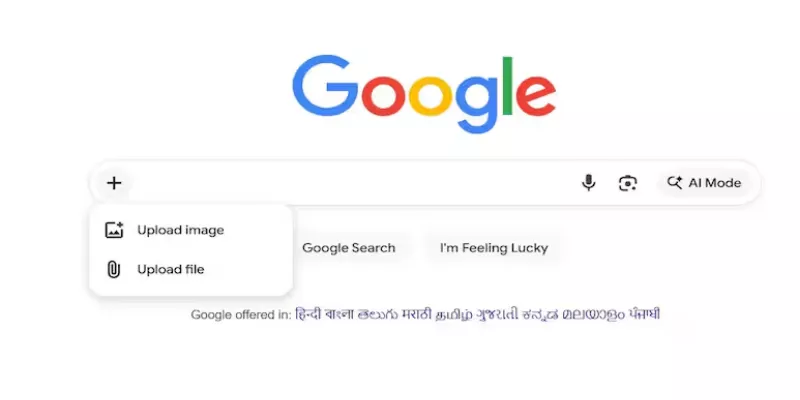
In late 2025, Google made a fairly significant change to its user interface with little fanfare. The new Google Search Plus button is the main visual that shows how search is changing. With the new Google Search plus button, the option of doing a traditional search is no longer the default one. This change is not a mere layer of AI search as Google usually rolls them out but rather it foresees the future where Google AI is the main way of searching.
This article is about the plus button, how the AI works with the new interface, why it is important for the end-user and what it signifies for SEO and the future of search.
What the Plus Button Is
The google search plus button is the small icon that you see on the left of the search bar on google.com. Without typing a query, you can now put in the search your content. By clicking on the plus icon, you simply:
- Upload photos to Google Search
- Upload files to Google Search
While the upload is going on, Google AI Mode is automatically launched by Google. This is a different kind of search; it is not the standard one and it is not Google Lens either. It is a fully AI-powered search designed to understand meaning, context, and intent.
Instead of sending you to websites that contain your keywords, Google AI search returns tailored solutions based on your input, web content, and the dialog with you.
How the Google AI Mode File Upload Feature Works
The Google AI Mode file upload feature is quite straightforward:
- Google Search is launched on a desktop computer.
- Next to the search bar, you hit the plus button.
- Now, you may decide to upload a picture or a document.
- Google does the content processing in AI mode.
- You keep on interrogating the AI in a conversational way.
This means that users do not need to change tools or modes. If you are still wondering how to upload files in Google AI search, just think that the plus button is now the quickest way.
To help with this task, the system uses Google Gemini search models that can handle text, images, charts, and PDFs. This goes beyond recognition. It is understanding.
From Keywords to Meaning
Conventional search was limited by its dependence on keywords and the ranking of pages. Google AI search is gradually doing away with that model.
Once a file or an image is uploaded by a user, the AI experience becomes the destination. Instead of going through the results, users get direct explanations, summaries, and insights. This is where AI Overviews Google and AI Mode come together.
So, the end product here is a conversational AI search flow where users can follow up with more questions naturally without having to rephrase their previous queries. This is a radical shift in how searching works.
Multimodal Search Becomes Standard
Now that users are given the choice to upload images to Google Search and upload documents to Google Search, they have essentially been introduced to the new standard of multimodal input. They can actually use photos, PDFs, slides, or screenshots as search inputs.
This is in line with Google’s overall strategy for the next generation of AI-driven search, where the focus is on the meaning rather than the keywords. Also, it is linked to earlier features such as AI Overviews, visual search, and Gemini-based interpretation.
Searching now feels closer to talking with an assistant than querying a database.
Google Search AI Update and Broader Strategy
The Google AI update is not a single instance, but rather a part of a wider rollout that comprises:
- One major component of the broader Google AI initiative to support handling of long-form questions is Google AI Mode
- AI Overviews Google to generate summary answers
- Canvas to collect AI-generated insights
- Search Live with visual context
The feature that allows one to click on the google plus button to upload images, and documents streamline the process and brings the users right into AI Mode. It makes the whole process more efficient and changes the way people interact with each other.
Impact of Google AI Mode on SEO
There are significant changes in the SEO landscape as a result of the introduction of Google AI Mode.
Users might hardly click on links as they get direct answers.
There might be a major change in traffic flow mainly from traditional ranking results.
The most important thing is to get featured in the AI-generated content since that is where the visibility will be coming from.
Writers have to focus on the creation of content that is AI-friendly and also meets the requirements of page one of the SERPs. Good content that is well-organized, rich in context, and comes from a trusted source will have a better chance of being cited by AI-generated answers.
This puts more importance on metadata, schema, and content clarity than ever before.
Privacy and Upload Considerations
The files that have user’s consent to be uploaded through the Google AI Mode are sent to Google’s servers for processing. This also entails that if you conduct an upload of images to Google Search or upload documents to Google Search, the files are still handled on the servers.
As a matter of good practice, users should always be aware of privacy policies, particularly when dealing with sensitive or confidential documents.
What This Means for Users
That is a significant change that, as a matter of fact, does a lot of time saving for the average users. Students can upload notes. Professionals can analyze reports. Creators can explore visual ideas. The Google AI Mode file upload feature removes friction and speeds up understanding.
However, one must bear in mind that the responses provided by AI are not always entirely accurate. A conversational AI search can give a very plausible answer although it may be incomplete. So, critical thinking is still very much needed.
Looking Ahead
The future of Google Search with AI is becoming clear. Search is no longer only about locating sources. It is about interpreting information.
The google search plus button might be a tiny one but it is a sign of an AI-first world. The default way people search could be by uploading their content and getting a single conversational response.
As things stand with the continuous development of google ai search, both creators and users will have to keep up. Search is no longer just typed queries and links. It is meaning, context, and conversation.