
The cargo does not announce itself. On a January morning in 2025, roughly 120 kilometres off the coast where Mauritania dissolves into the Atlantic, a gas flare lit the surface of the water at the Greater Tortue Ahmeyim field. Engineers on the floating production vessel recorded the numbers, first gas, flowing at last, and relayed them to an energy minister’s office in Nouakchott.
The image of that flare, which BP later transmitted as a kind of trophy, landed on a desk in a capital that had spent years being told it was waiting for a transformation. The waiting, at least in energy terms, was over.
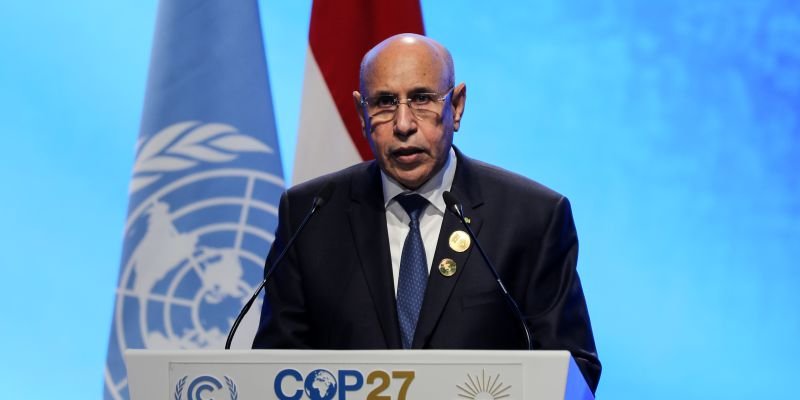
In Nouakchott itself, the city proceeded as it always does: methodically, without spectacle. There was no ticker-tape parade. No prime-time address. Mohamed Ould Cheikh El Ghazouani, the President of the Islamic Republic of Mauritania, did not hold a press conference. The moment passed in much the way his presidency tends to pass, consequentially, and almost silently.
This is the central paradox of the man and the country he leads. Mauritania is surrounded by a region that has become, in the past five years, among the most volatile on earth. Mali fell to a military junta in 2021. Burkina Faso followed.
Niger toppled its government in 2023, expelling French and then American military forces. Jihadi violence that once flickered at the edges of the Sahel now reaches into capital cities. Yet Mauritania, vast, desert, poor, squeezed between Algeria and Mali and the turbulent waters of post-colonial West Africa, has not had a coup since 2008.
Has not suffered a terrorist attack on its soil since 2011. Has, against every expectation embedded in its own history, managed two consecutive peaceful transfers between elected presidents. And in 2025, began exporting liquefied natural gas.
‘He is not a man who seeks the spotlight. He is a man who seeks the outcome.’ – A senior Mauritanian official
The question is whether this steadiness is architecture or luck. Whether Ghazouani has engineered a model for governance in fragile states, or whether Mauritania’s quiet is the quiet that precedes the storm, a surface that holds because the pressures beneath have not yet found their exit.
- STABILITY AS STRATEGY, NOT LUCK
Ghazouani was born in 1956 in Boumdeid, in the Assaba region, the son of a spiritual leader of the Ideiboussat, a Berber-Sufi family of significant standing. He memorised the Quran. He joined the army in the late 1970s, trained at the Royal Military Academy in Meknes, Morocco, and rose through a service that was, in those decades, less a profession than a political ecosystem.
Mauritania had seen a coup in 1978, another in 1984, a mutiny in 2003, another coup in 2005, and another in 2008, the last of which Ghazouani himself helped execute, alongside his then-partner and future predecessor, Mohamed Ould Abdel Aziz.
That history matters, because it means Ghazouani understands coups not as aberrations but as instruments, and understands, therefore, what conditions allow them to occur. A general who has studied instability from the inside is different from a civilian reformer who studies it from the outside.
By the time he ran for president in 2019, chosen as Aziz’s preferred successor, stepping down as Defence Minister to stand, Ghazouani had spent decades at the commanding heights of Mauritanian security. First as director-general of national security, then as chief of staff of the armed forces from 2008 to 2018.
His campaign posters carried a slogan that was less a boast than a promise: ‘the safe choice.’ He won in the first round with 52 percent of the vote, and the transition that followed was the first in Mauritanian history not imposed by force.
He was re-elected in June 2024 with 56 percent, again in the first round.
What Ghazouani built in the intervening years was not a dramatic reform agenda but a patient calibration of threat and response. The Sahel’s security collapse has many fathers: poverty, porous borders, foreign intervention that created vacuums rather than filling them, and the particular combustibility of states where the military learned that it could govern. Mauritania shared many of these conditions. What it lacked, or, more precisely, what Ghazouani worked to remove, was the trigger.
His approach to jihadist threats has been studied by analysts across the region. After a series of al-Qaeda in the Maghreb attacks that killed Mauritanian and foreign civilians between 2005 and 2011, the response was not simply military.
Ghazouani, then serving in the security apparatus, combined targeted operations with an unusual emphasis on community engagement, deradicalisation programmes, dialogue with Islamic scholars and brotherhood leaders, an attempt to address the grievances that extremist recruiters exploit. It is the kind of approach that produces few dramatic headlines and considerable quiet.
Mauritania has not recorded a terrorist attack on its soil since 2011. Its neighbours have been consumed by exactly the violence it has avoided.
The costs of this stability are real and should not be airbrushed. Mauritania remains a country where significant restrictions on press freedom and civil liberties persist. Slavery, historically entrenched in a society stratified by race and caste, is technically illegal but practically ongoing; the country’s most prominent opposition figure, Biram Dah Abeid, is an anti-slavery activist who came second in both the 2019 and 2024 elections, winning 22 percent of the vote.
The 2024 election, while certified by the independent electoral commission, was contested by Abeid, who alleged manipulation. Post-election protests in the southern city of Kaédi resulted in three deaths and a temporary internet shutdown. These are not footnotes. They are the texture of the trade-off.
Ghazouani’s supporters argue that the alternative to cautious stability is not vibrant democracy but accelerated collapse. They point to the arc of Sahel states where pressures were allowed to boil rather than managed. The argument is not without merit. But it asks a great deal of those on whom the costs of stability fall most heavily.
- THE ENERGY PIVOT THAT CHANGED THE STAKES
In the language of geopolitics, Mauritania has for decades been described in terms of what it lacks: depth, population, institutions, resources. The Greater Tortue Ahmeyim field, discovered in 2015, began to change that vocabulary.
In December 2024, first gas flowed. In February 2025, first LNG was produced. In April 2025, the first cargo was loaded and exported, BP, operating alongside Kosmos Energy and the national oil companies of Mauritania and Senegal, confirming both countries as LNG-exporting nations for the first time in their histories.
The scale of Phase 1, approximately 2.3 to 2.4 million tonnes of LNG per year, is modest by global standards. Nigeria’s LNG capacity is roughly ten times that figure. But in the specific context of Mauritanian state finances, which have long depended on iron ore and fish, the revenue flows represent a structural shift.
The World Bank projected growth averaging 4.9 percent for the period 2024 to 2026, with gas production as the primary spur. The IMF and the government have spoken about using the fiscal space to fund social protection and investment programmes.
The GTA field, located in waters up to 2,850 metres deep on the maritime border with Senegal, represents a total investment of roughly five billion dollars for Phase 1 alone. Phase 2 negotiations, reported in May 2025, aim to double production capacity to five million tonnes per annum. A third phase would extend the field’s productive life across a horizon of thirty to fifty years, according to BP estimates. Further offshore, the ultra-deepwater BirAllah gas project was advancing toward a final investment decision in 2025.
And beyond hydrocarbons, Mauritania’s extraordinary solar irradiation, it is among the sunniest countries on earth, and Atlantic wind resources have drawn the interest of European governments seeking green hydrogen supplies as part of their energy transition strategies.
‘For a nation whose people have often remained on the edges of regional growth, projects like GTA are igniting hopes of economic transformation.’ – African Business
The risks of this energy pivot are well-documented by economic history. Resource wealth has, across African and other developing economies, as often entrenched inequality as resolved it. It creates new patronage networks, attracts the geopolitical attention of major powers whose interests do not always align with local populations, and generates expectations that governments, even competent ones, struggle to meet.
Nearly 60% of Mauritania’s 4.9 million people live in poverty, primarily in subsistence farming or the informal economy. In a country where almost three-quarters of the population is under 35, energy revenue that flows into government coffers without visible improvement in daily life can become its own political destabiliser.
Ghazouani’s administration has framed the GTA project as a vehicle for long-term transformation rather than immediate distribution. The programme includes local employment, construction activities generated more than 3,000 jobs, and commitments to apprenticeship and supplier development.
Whether these commitments translate into systemic change, or whether they remain contained within the geography and timelines of the offshore project, will be a defining test of the presidency’s second term.
In Nouakchott, the tangible signs of shifting global attention are visible in small ways. New embassies have appeared. European energy delegations pass through with increasing regularity. The country’s profile in international financing conversations has risen. Ghazouani has navigated this attention with the same restraint he brings to everything: engaged, but not dazzled.
- GOVERNANCE WITHOUT NOISE
The trial of Mohamed Ould Abdel Aziz was, in the annals of African governance, a genuine rarity. A former head of state, Ghazouani’s predecessor, political mentor, and onetime closest ally, was tried, convicted, appealed, and had his sentence increased from five to fifteen years in prison on corruption charges.
The Supreme Court confirmed the conviction in November 2025. Authorities froze assets worth approximately one hundred million dollars. The case, which Mauritanian journalists came to call the ‘Decade of Corruption’ trial, for the decade of Aziz’s rule, is considered the longest in the country’s history and one of the very few instances on the continent of a former head of state being held to account for financial crime rather than blood crime.
The interpretation of this episode is genuinely contested. Those who see it as a signal of institutional maturity note that prosecutorial independence, however imperfect, was maintained through multiple courts and multiple appeals. The outcome held. The man who was prosecuted is now definitively jailed.
Those who see it as a political operation note, accurately, that Ghazouani and Aziz had fallen out within months of the 2019 transition, that the parliamentary probe which initiated proceedings was launched in 2020 when their relationship had already soured, and that Aziz himself claimed the charges were score-settling. He even claimed, in one of the trial’s more remarkable moments, that Ghazouani had handed him suitcases of cash after the 2019 election, a claim Ghazouani’s administration denied.
The truth, as with most exercises of state power, is probably not simply one thing. What is not in dispute is that the trial happened, that it concluded without the intervention of a praetorian guard, that no coup was launched in Aziz’s defence, and that the courts, whatever their limitations, functioned. In a region where accountability for former leaders is almost universally avoided, this is not nothing.
Beyond the trial, Ghazouani’s governance style has been characterised by what one might call productive understatement. Digital governance platforms have been extended. Investment codes have been revised to reduce bureaucratic friction and improve the environment for foreign capital.
Social protection programmes, housing construction, health insurance, have reached, according to government figures, around 1.5 million people classified as poor. These are not transformational statistics, but they represent steady accretion.
At the same time, the political landscape involves a pattern of co-optation that critics find troubling. After the 2024 election, Ghazouani initiated a national dialogue that drew in parties including those of candidates who had contested him, a process that critics argue is less genuine pluralism than a mechanism for absorbing opposition and defusing it. The historical precedent, a previous republican pact that saw opposition parties declare loyalty to the ruling party, suggests that dialogue in Mauritanian politics can serve containment as much as consultation.
Is this cautious reformism enough in a country where poverty remains pervasive, youth unemployment is high, and institutional trust has historically been thin?
Youth unemployment and emigration remain acute pressures. With over 70% of Mauritania’s population under 35, the country generates far fewer formal jobs than it needs. Young Mauritanians increasingly attempt the journey to Europe, some through the Western Sahara route to the Canary Islands, driven by the arithmetic of limited opportunity at home.
This migratory pressure has itself become a source of geopolitical leverage: European governments concerned about West African migration routes have been attentive to Mauritania’s stability in ways that translate into diplomatic and financial attention. It is a relationship that suits Ghazouani’s government, but it also creates dependencies that can constrain as much as they enable.
- THE RELUCTANT CONTINENTAL
Ghazouani chaired the African Union from February 2024 to February 2025, a role that, by the account of multiple diplomatic sources, he assumed reluctantly. Mauritania was put forward as a compromise candidate after Morocco and Algeria, both seeking the rotating chairmanship, spent two years blocking each other’s candidacies in a dispute that threatened to paralyse the North African caucus. Mauritania, with its careful non-alignment between the Maghreb’s rival powers, its functional state, its relative neutrality, was the solution that no one was enthusiastic about and everyone could accept.
The moment he inherited was genuinely difficult. Sudan was in a civil war. The Alliance of Sahel States had broken from ECOWAS, creating institutional fractures in West African governance. Senegal’s presidential election had been postponed amid constitutional tensions.
Ghazouani’s chairmanship brought none of the rhetorical flair of some of his predecessors, but it brought what he consistently offers: a platform for conversation, a refusal to inflame, and a credibility derived from presiding over a country that has, however imperfectly, maintained civilian governance in the middle of a coup epidemic.
By July 2025, Ghazouani was in Washington, joining four other West African leaders at a White House summit with President Donald Trump, promoting Mauritania’s mineral resources and strategic positioning. In October 2024, he had attended the BRICS summit in Kazan, meeting with President Putin.
He navigated the Russia-West fault line, which has divided the Sahel’s coups from its remaining democracies, with studied non-commitment, maintaining relationships on multiple sides without sacrificing the Western partnerships that underpin much of his foreign investment and security cooperation.
This multi-directional positioning is itself a form of strategy. In a region where governments have been forced by domestic politics or external pressure to choose sides, France or Russia, the West or the Alliance of Sahel States, Mauritania has preserved the option of talking to everyone. It is a small-country diplomacy, the diplomacy of a nation that cannot afford enemies, refined into a conscious posture.
- THE WEIGHT OF QUIET
Return to the offshore silence of January 2025, where the gas first flowed and the flare lit the Atlantic dark. It is tempting to read that moment as a metaphor for the country and the man: something consequential happening far from shore, in deep water, with minimal ceremony. The cargo ships come, are loaded, and depart. The revenue accrues. The institution holds.
What Ghazouani has built in six years is, by any reasonable accounting, a functioning state in a neighbourhood where the very concept has been under assault. He has maintained civilian governance, prosecuted a predecessor, overseen an energy transition, chaired a continental body, and kept the jihadist pressure that has consumed his neighbours from breaking through his borders.
He has done it without charisma as a political tool, without the nationalist rhetoric that makes leaders popular in the short term and brittle in the medium term, and without the spectacular gestures that attract global attention and then dissipate into nothing.
The questions that linger are not small. Whether his government’s approach to slavery and racial inequality, long-standing structural wounds in Mauritanian society, will move beyond gesture.
Whether the energy revenues that are beginning to flow will be managed with the transparency the country’s institutions still struggle to guarantee. Whether the opposition that has been absorbed into national dialogue will, over time, find that it has been silenced rather than included.
Whether the youth of a country where three-quarters of the population is under 35 will find in the stability Ghazouani has engineered a platform for their ambitions, or a ceiling.
In October 2024, a military reshuffle tightened control of the armed forces further. In December, following reported Algerian military incursions into Mauritanian territory, the appointments signalled that the borders of quiet stability require active maintenance. The neighbourhood is, as a member of the African Union once observed, burning. Mauritania is not fireproof. It is, for now, simply better insulated than the rest.
In a region where governments have collapsed trying to be everything at once, Ghazouani has chosen to be one thing steadily. The question is whether that is wisdom, or whether the pressures he has managed will eventually find a way past him.
One evening in Nouakchott, the desert wind that locals call the harmattan moves through the city in the hour before prayer. The call rises from the mosques. The ministry buildings are dark. Somewhere to the northwest, offshore, the Gimi FLNG vessel rides at anchor, the first LNG cargo long since loaded and delivered.
In the presidential palace, behind a schedule that produces almost no press releases and very few photographs, a former general sits with his advisers and considers the long game.
That, in the end, is the question Mauritania poses to its neighbours and to the watching world: in fragile regions, is steadiness enough? Can a leader who governs without noise build something that endures?
Or is the silence that surrounds Ghazouani’s presidency not the silence of a system at peace with itself, but the silence of pressures gathering quietly, in deep water, waiting to surface?