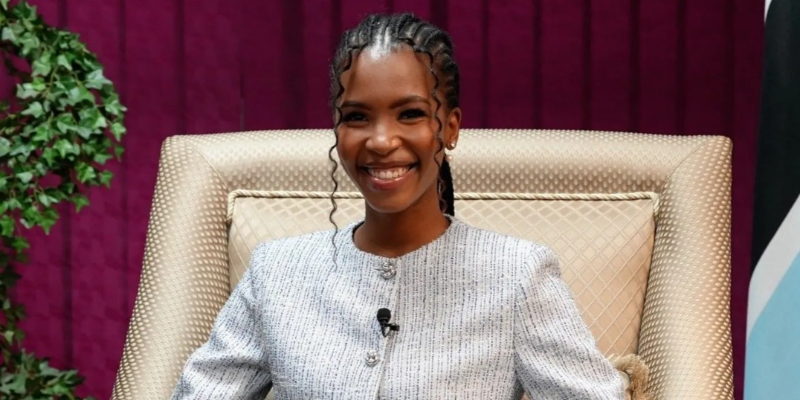
Botswana is witnessing the rise of a leader who represents a generational shift in African leadership. Lesego Chombo, former Miss World Africa 2024, stepped into government with an appointment that immediately signalled intent. In November last year, she became Botswana’s Minister of Youth and Gender at just 26 years old.
Her age has drawn headlines. Her work is what is earning attention.
Chombo has quickly evolved into a persuasive voice in national debates, speaking with clarity on issues that shape the everyday reality of young people and women. Youth unemployment. Gender-based violence. The systemic structures that keep opportunity out of reach for many. These are complex challenges, and she has shown an ability to frame them as economic priorities, social priorities, and national stability priorities at the same time.
In a political environment where public trust can feel fragile, her communication style stands out. She speaks directly, carries public confidence, and brings a modern tone into leadership spaces that often move slowly.
Positioning Youth Unemployment as a National Economic Emergency
Chombo has made one thing clear early in her tenure: youth unemployment requires urgency, and it requires seriousness at policy level.
While presenting her ministry’s 2025/2026 budget proposal to Members of Parliament earlier this year, she described youth unemployment as one of the most pressing issues facing Botswana. It was a deliberate message, and it landed.
The numbers support her position.
34.9 percent of Botswana’s population consists of young people aged 15 to 35. Within this group, 41.3 percent fall under the NEET category, meaning they are not in education, employment, or training. This is more than a statistic. It is a warning signal.
A large youth population can become a national advantage when skills meet opportunity. Yet when youth remain economically excluded, the consequences ripple outward: weakened productivity, higher dependency pressures, and growing frustration across communities.
Chombo’s strategy has been to frame youth inclusion as an economic growth requirement, rather than a social side project. That shift matters because budget decisions follow political prioritisation. When youth unemployment is treated as central, investments begin to move toward solutions that scale.
Making Gender Policy About Systems, Safety, and Financial Access
Chombo’s portfolio covers youth and gender, two spaces where policy can either transform lives or get stuck in symbolism. Her positioning shows ambition for real change.
On gender, she has pushed for systemic shifts aimed at removing barriers to women’s empowerment. Her focus has included stronger protection against gender-based violence and expanded access to financial services and social protection.
This approach reflects an understanding many leaders overlook: empowerment is built through systems, not speeches.
Safety drives participation. Financial access drives independence. Social protection creates resilience. When women have stronger legal protections and greater economic inclusion, the entire economy benefits through higher workforce participation, improved household stability, and broader entrepreneurship.
Chombo’s framing treats gender reform as a national development strategy, tied to productivity and long-term stability.
Strengthening Justice Systems to Respond to Gender-Based Violence
A major weakness in gender-based violence response across many countries is the gap between policy language and real-world enforcement. Chombo has shown intent to close that gap through institutional strengthening.
She has backed the justice department’s rollout of specialised training for judges and judicial officers to help them handle gender-related cases more effectively. This signals a sharper understanding of where systems often fail.
Legal protections matter only when courts and judicial processes can apply them with competence, consistency, and sensitivity. Specialised training improves case handling, strengthens accountability, and increases confidence in institutions that survivors depend on.
For Botswana, this reinforces a clear message: gender-based violence is being treated as a priority that requires professional capacity, not only public statements.
A Leadership Style Built on Visibility and Representation
Chombo’s rise also signals something deeper: young people are stepping into leadership roles with the lived awareness of what youth exclusion feels like.
When asked about the biggest challenge facing young people in Africa and globally, she highlighted something many policymakers struggle to quantify: young people feeling unseen and unheard.
That experience, when widespread, creates real consequences. It shapes how young people engage with education, work, and civic participation. It influences social stability. It impacts trust in institutions.
Chombo has linked that feeling directly to outcomes such as unemployment, underemployment, political unrest, and the broader belief among young citizens that they lack a seat at the table to make decisions for themselves.
This insight is one of her strongest leadership assets. It shows she is listening to the emotional reality behind economic data, and translating it into a policy agenda.
That combination is rare: empathy paired with urgency.
The Business Case for Youth and Gender Reform
Botswana’s future growth depends heavily on how well it integrates its youth population into productive economic pathways. It also depends on how effectively it creates an environment where women can participate fully and safely.
Chombo’s leadership touches both.
Youth unemployment is a pipeline problem: education to employability, training to access, opportunity to execution. Gender empowerment is a systems problem: safety, legal enforcement, financial access, and institutional confidence.
Solving either requires coordination across government, private sector, and communities. Solving both requires leadership that can communicate clearly, hold attention, and push for action.
Chombo has begun doing exactly that.
A New Generation, A New Standard
Lesego Chombo represents a new crop of African leadership that is younger, more visible, and more willing to speak directly about hard national issues.
Her appointment at 26 has brought heightened expectations. Yet her early performance suggests she understands the weight of the role. She is shaping debates, backing reforms, and placing youth and gender priorities where they belong: at the centre of national development.
Botswana’s biggest advantage is its stability and governance reputation. The next advantage depends on whether its young people can find opportunity at home, and whether its women can move through society with safety and financial independence.
Chombo’s leadership is emerging at exactly the right time.
And if her momentum continues, she may become one of the most important political voices Botswana has produced in this new era of African leadership.