
This case study examines how poverty in Sub-Saharan Africa and income inequality combine to suppress national development across the region. It draws on evidence from Nigeria, Uganda, and Kenya to show that the problem is not simply a lack of growth, it is growth that consistently bypasses the people who need it most.
Using data from the World Bank, UNDP, IMF, and peer-reviewed research, the study traces the links between inequality and weaker outcomes in education, health, governance, and long-term economic productivity. It also looks at what has worked: social protection programmes, health reform, agricultural investment, and smarter tax systems have all produced measurable results in specific contexts.
The central finding is straightforward. Without deliberate policy to redistribute opportunity, economic growth in Sub-Saharan Africa tends to deepen existing divides rather than close them. That pattern has consequences not just for individual households, but for entire national economies.
Why This Matters – and Why It Is Misunderstood
In 2001, Nigeria sold more oil than it had in any previous decade. Its GDP climbed. International investors were interested. And yet, between 2000 and 2010, the number of Nigerians living in extreme poverty grew by nearly 22 million people.
That contradiction is at the heart of what this case study is about. Sub-Saharan Africa has produced some genuinely impressive growth numbers over the past two decades. Commodity booms, mobile technology, and improved governance in a handful of countries pushed GDP figures upward and attracted confident predictions of an “African Century.”
But headline growth, it turns out, tells you almost nothing about whether a truck driver in Kano, a smallholder farmer in western Uganda, or a single mother in Nairobi’s Kibera settlement is better off.
Poverty in Sub-Saharan Africa is not a relic of stagnation. It coexists, stubbornly, with growth. And income inequality is the mechanism that explains how.
The numbers are hard to absorb. 431 million people in Sub-Saharan Africa live on less than $2.15 a day, more than 60% of the world’s extreme poor, in a region that holds roughly 14% of the world’s population (World Bank, 2022). If current trajectories hold, the region will account for more than 90% of the projected growth in global extreme poverty by 2030. These are not distant projections. They describe what is already in motion.
The Form of Inequality in Sub-Saharan Africa
Inequality in this region is not uniform. It takes different forms in different places, and those differences matter for how it should be addressed.
South Africa sits at one extreme, a Gini coefficient of roughly 63, the highest recorded for any country in the world (World Bank, 2023). The legacy of apartheid left behind a property and income structure that post-apartheid policy has proved unable to fully unwind.
Namibia, Botswana, Zambia, and Mozambique all sit above 50. These are not subtle gaps between income brackets. They are chasms, reflected in the quality of schools, the accessibility of hospitals, and whether your home has running water.
What makes inequality in Sub-Saharan Africa particularly damaging is how it layers. Income inequality compounds educational inequality, which compounds health inequality, which eventually feeds back into income. The World Bank’s analysis of intergenerational mobility across the region consistently shows that where you are born, and to whom, remains one of the strongest predictors of where you end up. That is not an accident. It is the structure of the system.
“A 1 percentage point increase in the income share of the top 20% is associated with a 0.08 percentage point decline in GDP growth over five years. Inequality does not just harm the poor, it harms everyone.” — IMF Staff Discussion Note, 2015
The IMF’s research makes clear that high inequality is not just a social problem. It is a brake on the economy itself. When large portions of a population cannot access quality education, cannot afford healthcare, and have no access to credit or formal markets, economies lose enormous productive potential. The argument for reducing income inequality and national development outcomes are therefore one and the same.
Three Countries, Three Lessons
Nigeria: The Cost of Growth That Concentrates
Nigeria’s story is instructive precisely because it contains so much potential alongside so much failure. Africa’s largest economy by GDP. A young, fast-urbanising population. A film industry that rivals Bollywood in output.
And yet, an estimated 86 million people in extreme poverty, a public health system spending approximately 0.6% of GDP, and a north-south divide so stark it could be two different countries (World Bank, 2022).
The oil economy explains much of it. Between 1960 and 2000, Nigeria earned over $600 billion in oil revenues (Sala-i-Martin and Subramanian, 2003). The benefits flowed primarily to a narrow political and business elite concentrated in a few urban centres. Public investment in education, rural infrastructure, and healthcare, the things that might have spread opportunity more widely, stayed chronically underfunded.
Poverty in the north, where over 70% of Nigeria’s poor live, is now so entrenched that it has created conditions for persistent instability and conflict that further suppress development.
There is a useful thought experiment here. Two children born in Nigeria the same year. One in a Lagos household in the top income decile, private school, reliable electricity, access to private healthcare.
The other in Zamfara State in the northwest, an understaffed school, limited clean water, a family dependent on rain-fed agriculture. The structural forces shaping those two trajectories have almost nothing to do with individual effort or talent. They are the direct result of how resources, services, and opportunity are distributed.
Uganda: When Growth Stalls Before It Reaches Everyone
Uganda achieved something genuinely impressive in the 1990s and 2000s. Coming out of the Amin and Obote eras, it posted sustained GDP growth above 6% annually and reduced the share of its population in extreme poverty from over 56% in 1993 to around 21% by 2017 (Uganda National Household Survey, 2017). That is real progress.
But progress is fragile when its foundations are narrow. Uganda’s Gini coefficient sat at 42.8 in 2017, and the rural-urban gap had widened rather than closed. Over 70% of the population still works in subsistence agriculture, a sector that receives minimal public investment and is increasingly at the mercy of climate variability. Droughts in recent years have pushed hundreds of thousands back below the poverty line, erasing gains that took years to achieve.
The education story is particularly telling. Uganda’s 1997 Universal Primary Education programme dramatically increased school enrolment, which looked like a win. But classroom sizes ballooned, teacher pay stayed low, and the quality of instruction declined. Many children completed primary school without learning to read or do basic maths, leaving them ill-equipped for the economy they were entering. Access without quality is not equity. It is the appearance of equity.
Kenya: What Innovation Can and Cannot Fix
Kenya is the region’s most cited success story in financial inclusion, and the evidence backs it up. M-Pesa, the mobile money platform launched by Safaricom in 2007, now has over 50 million users and has measurably reduced poverty for some of its users.
Research published in Science found that access to M-Pesa lifted approximately 2% of Kenyan households out of poverty by enabling savings and small transactions that were previously impossible (Jack and Suri, 2016). That is meaningful.
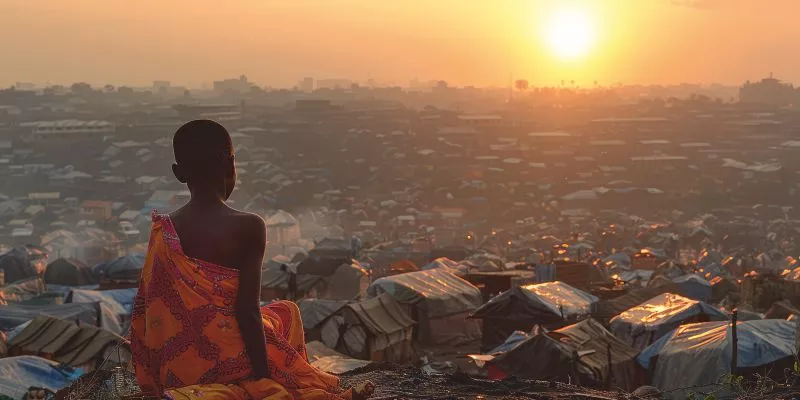
But innovation does not restructure land ownership. It does not rebuild a neglected county hospital. And it does not close a Gini coefficient of 38.7 (World Bank, 2021). Nairobi holds both the continent’s most vibrant tech startup ecosystem, known as Silicon Savannah, and Kibera, one of Africa’s largest informal settlements, where an estimated 700,000 people live without reliable clean water or sanitation.
Kenya’s 2010 constitutional devolution was a more structural attempt to address inequality, devolving resources and decision-making to 47 county governments, partly in response to the 2007-08 post-election violence that had deep roots in regional and ethnic grievance. It has improved service delivery in previously neglected areas.
But the World Bank’s 2023 Kenya Economic Update notes that counties in the arid north still lag dramatically behind on health, education, and income metrics. Structural inequality does not yield to technology or decentralisation alone. It needs sustained, targeted redistribution.
Why Inequality Blocks Development: The Mechanisms
The damage is not abstract. It moves through specific, well-documented channels.
- Education gaps that persist across generations. UNESCO estimates that children from the richest households in Sub-Saharan Africa are four times more likely to complete secondary school than those from the poorest (2023). The World Bank puts the lifetime earnings cost of learning poverty at up to $1.2 trillion for the region. Those are not statistics about the past. They are a description of tomorrow’s workforce.
- Health inequality that taxes the whole economy. Sub-Saharan Africa accounts for roughly 70% of global maternal deaths and 56% of deaths in children under five, almost all preventable with adequate healthcare access (WHO, 2023). Malaria alone costs the region an estimated $12 billion per year in lost productivity (African Leaders Malaria Alliance, 2021). When large portions of a workforce are ill, under-nourished, or caring for dying relatives, productivity suffers at a macroeconomic level.
- Political capture by elites. High income inequality tends to concentrate political influence in the same hands as economic power. The result: tax systems designed to protect wealth at the top, public spending that favours urban infrastructure over rural services, and governance that manages inequality rather than addressing it. The AfDB’s 2023 African Economic Outlook found that institutional quality, meaning accountability, rule of law, and low corruption, was one of the strongest predictors of development outcomes across the region, independent of natural resource wealth.
- Climate change as an inequality multiplier. The region contributes less than 4% of global greenhouse gas emissions but faces some of the most severe climate impacts (IPCC, 2022). Droughts, floods, and erratic rainfall hit smallholder farmers hardest, the people with the fewest assets to fall back on. The World Bank estimates that without action, climate change could push an additional 40 million Sub-Saharan Africans into extreme poverty by 2030 (World Bank, 2020).
What Has Actually Worked
The record is not uniformly bleak. There are clear, replicable examples of policy working.
Rwanda’s health transformation
After the 1994 genocide left Rwanda with a collapsed health system and a life expectancy of 35 years, the government rebuilt around community-based health insurance, Mutuelle de Sante, which now covers over 90% of the population.
By 2022, life expectancy had risen to 69 years. Child mortality fell 80% between 2000 and 2020. Maternal mortality dropped 78% (WHO/UNICEF, 2021). Rwanda demonstrates that health equity is achievable, even from the most extreme starting points, when political will and institutional capacity align.
Ethiopia’s social protection at scale
Ethiopia’s Productive Safety Net Programme provides cash and food transfers to chronically food-insecure households while linking them to public works and agricultural support. At its peak, it reached over 8 million beneficiaries and contributed to a 30% reduction in food insecurity in target areas (World Bank Impact Evaluation, 2014).
It also helped fund Ethiopia’s broader agricultural transformation: between 2010 and 2020, the country more than doubled agricultural output, and extreme poverty fell from 44% to under 24% (World Bank, 2022).
Fixing revenue – Africa’s quiet crisis
The average tax-to-GDP ratio in Sub-Saharan Africa is roughly 16%, compared to 34% in OECD countries (OECD, 2023). That gap represents the difference between governments that can fund public services and governments that cannot. The AfDB estimates Africa loses approximately $88 billion per year through illicit financial flows, largely through multinational corporate tax avoidance (AfDB, 2020). Addressing that single issue would do more for development financing than most aid programmes currently in existence.
Conclusion
The story of poverty in Sub-Saharan Africa is not a story of economic failure. It is a story of economic success that has been repeatedly captured before it reached the people who needed it. Growth has happened. In many countries, it has been sustained. What has not happened, not consistently, not at scale, is the redistribution of that growth into education, healthcare, land rights, and political voice for those at the bottom.
Nigeria, Uganda, and Kenya each illustrate a different version of the same problem. When the benefits of growth concentrate in extractive industries and urban elites, when tax systems fail to mobilise revenue, when public services underfund rural areas and reward the already-connected, inequality does not just persist. It deepens, and development stalls.
The fixes are not mysterious. Rwanda showed what a functional health system can do. Ethiopia showed what agricultural investment and social protection can achieve. Kenya showed that financial innovation can reduce poverty, and also showed its limits when not backed by structural change.
Three things stand out as essential:
- Growth must be designed to include. Labour-intensive industries, rural infrastructure, and access to credit for small enterprises do not happen by default, they require deliberate policy.
- States need revenue to govern well. That means progressive taxation, closing loopholes for corporations, and stopping illicit financial outflows that drain public budgets.
- Inequality is political. It will not be resolved by market forces alone. Accountable institutions, free media, and civic participation are not soft goals, they are the conditions under which redistribution becomes possible.
The people this case study is ultimately about, the farmer in Zamfara, the student in a Ugandan classroom with forty classmates and no books, the entrepreneur in Kibera building something real on a mobile phone, are not waiting to be saved. They are navigating systems that were not built with them in mind. The question for policymakers, researchers, and international institutions is whether those systems can be rebuilt before 2030 closes out its promises.
The evidence says they can. The evidence also says it will not happen on its own.