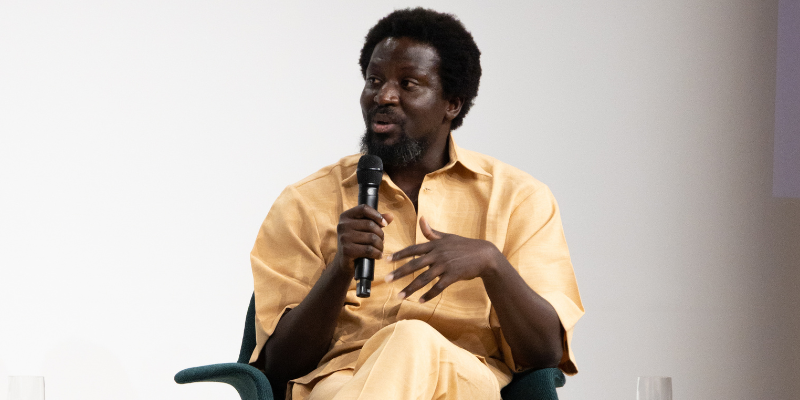
Some years shift a career forward. Others reshape an entire industry. For Ibrahim Mahama, 2025 became the year his impact reached its strongest global peak yet. ArtReview placed him at the very top of its annual power list, naming him the Most Influential Figure in the Art World. The recognition carried historic weight, marking the first time an African artist led a ranking shaped by an international panel of judges.
For the global art economy, this announcement signaled more than prestige. It reflected a wider transition in where cultural influence is created, funded, and scaled. Mahama’s rise also revealed a new model of leadership: one where artistic vision fuels institutional growth, global partnerships, and local transformation at the same time.
From Student Curiosity to Global Recognition
Mahama’s connection with the ArtReview power list began years before his own name appeared in international conversations. While studying at Kwame Nkrumah University of Science and Technology in Ghana in 2011, he first came across the ranking. At that time, Chinese dissident artist Ai Weiwei held the top position.
Mahama later reflected on how powerful that moment felt, especially for someone working from Ghana, a place that for years struggled to gain space within global art discourse. The 2025 listing, in his eyes, carried humility, gratitude, and a deep awareness of what representation truly means.
In the business of influence, timing matters. Yet timing alone does very little without strategy. Mahama’s journey shows how long-term consistency, a clear point of view, and disciplined execution can build a brand strong enough to change the center of gravity in a global industry.
The Signature Work That Became a Market Signal
Mahama gained international prominence through large-scale installations that are instantly recognizable. His materials often include jute sacks and remnant textiles, including cloth left behind by Ghana’s cocoa industry. These fabrics are stitched together by teams, assembled into vast quilt-like structures, then draped over buildings and architectural spaces.
This approach carries a strong operational and leadership story behind it. The work is collaborative, labor-intensive, and deeply tied to supply chains. His installations blend concept, craftsmanship, logistics, and scale, turning raw material into monumental public statements.
For the art market, scale creates attention. Attention creates demand. Demand builds value. Mahama’s work delivers all three, while staying rooted in purpose. It speaks about labor, extraction, and exploitation, issues that sit at the heart of global trade conversations today. In a world where consumers, investors, and institutions increasingly reward values-driven leadership, his work functions as both creative output and cultural intelligence.
Turning Proceeds Into Institutions, Strategy Into Legacy
Many artists build careers by selling work. Mahama has built something closer to an ecosystem. A defining element of his leadership has been his decision to channel sales proceeds into long-term institutions in Tamale, his hometown.
This reinvestment strategy stands out because it treats success as infrastructure. It treats recognition as fuel for building institutions that outlast trends. It treats creative capital as a resource that can be deployed the way entrepreneurs deploy revenue: toward talent development, community value, and long-term growth.
His growing network includes the Red Clay Studio, the Savannah Centre for Contemporary Art, and Nkrumah Volini. These spaces host residencies, student projects, children’s workshops, and exhibitions. Together, they form an operating system for creative development, designed to expand access, build skills, and strengthen cultural output from the ground up.
From a business lens, these institutions function like innovation labs. They develop talent pipelines. They create learning environments. They attract collaborators. They strengthen local economies. They also build cultural IP that can travel globally while remaining anchored locally.
Global Platforms, Institutional Validation, and Expanding Reach
Mahama’s credibility has also been strengthened through participation in major international exhibitions. He has shown work at the Venice Biennale and Documenta, two of the most influential platforms in contemporary art. These appearances act as global endorsements, validating relevance, scale, and execution in front of the industry’s most powerful gatekeepers.
His work has also entered public collections worldwide, including the Pompidou Centre in Paris and the National Gallery of Art in Washington, D.C. For a business magazine audience, this level of institutional acquisition matters because it signals enduring value. Collections operate like blue-chip portfolios. They acquire based on history, cultural significance, and long-term impact.
This global presence enhances Mahama’s positioning, elevating his influence beyond exhibitions into policy conversations, education programs, and long-term cultural investment trends.
The Business Lesson Behind Mahama’s Rise
Ibrahim Mahama’s 2025 recognition tells a story bigger than one individual ranking. It showcases a new blueprint for influence built through three key pillars:
Scale with purpose: Large installations that capture attention while addressing global economic realities.
Reinvestment as strategy: Sales proceeds directed into institutions that build long-term value.
Global reach with local roots: International acclaim paired with deep commitment to Tamale’s creative future.
In a market that rewards impact, Mahama stands as proof that cultural leadership can operate like enterprise leadership. His work builds value through people, process, and vision. His institutions multiply opportunity. His global recognition reinforces what his strategy has already proven: influence grows fastest when it creates outcomes far beyond the spotlight.
As 2025 unfolds in the art world and beyond, Mahama’s story serves as a case study in modern leadership: bold enough to scale globally, grounded enough to build locally, and strategic enough to turn creative power into a lasting legacy.