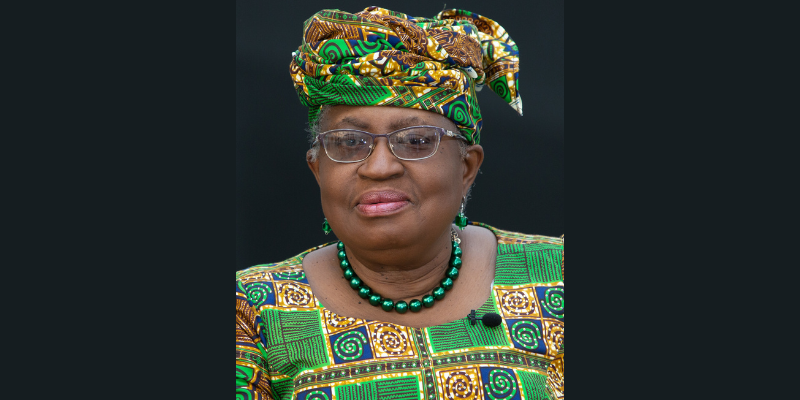
Dr. Ngozi Okonjo-Iweala leads the World Trade Organization (WTO) as its Director-General, the first woman and the first African to hold this post in the organization’s history. Since assuming office in March 2021, she has steered the WTO through one of the most challenging eras in global commerce, marked by rising protectionism, supply-chain disruption, and calls for reform of the multilateral trading system.
Her appointment was a milestone for global governance, reflecting confidence across regions and development levels in her ability to bring fresh leadership to a forum that shapes rules affecting billions of consumers and trillions in trade flows.
From Economics to Trade Leadership
Okonjo-Iweala’s ascension to the leadership position of the WTO is the culmination of a notable career that embraced public finance, international development, and global economic strategy. Prior to the WTO, she was with the World Bank for over 25 years, where she eventually rose to the rank of Managing Director for Operations, in charge of a portfolio amounting to $81 billion spread across different regions.
She also had two terms as Nigeria’s Minister of Finance, where she was an advocate of transparency, macroeconomic reform, and reinforced fiscal systems among her accomplishments. This resulted in Nigeria being given its very first sovereign credit ratings and financial governance reforms being extended deeper.
In addition to her public service, she ground her experience in the corporate world by serving on the boards and chairing institutions dealing with global health and risk management, such as Standard Chartered PLC, Gavi, the Vaccine Alliance, and the African Risk Capacity. Such an experience works together with her openness to the world and her trade leadership style in multi-lateral scenarios.
Championing Inclusive Trade
At the WTO, Okonjo-Iweala is in a situation where the global trade policy has to consider a lot of different national interests and at the same time economic goals that are more general. She has been very vocal about the fact that fair trade has the power to bring about development, especially for the low-income countries that want to be part of global value chains.
Her leadership has taken on the difficult task of negotiating, which includes the alignment of WTO rules with the challenges of the 21st century like digital trade, investment facilitation, and the recovery from the pandemic. She has been in support of reforms that tackle the issues of the persistent consensus decision-making and the changing geopolitical pressures at the same time, stressing the need to maintain the relevance of the WTO by using dialogue as means not confrontation.
Her position on divisive trade matters has always been on the line that her principle is multilateral trade should be at the same time resilient and responsive. She has been reinstalling the calls for modernization of the WTO mechanisms, where she argues that efficiency and inclusivity are not opposing sides of the coin but rather the two sides of the same coin that is essential for the global economy to continue to grow.
A Voice for Development and Reform
The WTO has been having hard discussions regarding equity, under the leadership of Okonjo-Iweala. She is of the opinion that the future technologies such as AI, if uncontrolled, will worsen the economic disparity between the rich and the poor countries. This is a concern that falls under trade policy, digital readiness, and competitiveness of nations worldwide.
Her presence at the WTO site suggests that trade policy is not only about tariffs and access to markets but also the intersection of growth, infrastructure, and economic stability. She sees the WTO as a place where the East and West can come together to seek solutions to their structural challenges and priorities that are common to them both.
Leadership With Global Reach
Okonjo-Iweala’s impact extends beyond trade negotiations. She sits on global commissions on economy and climate, participates in high-profile pandemic preparedness panels, and contributes to dialogues that shape international economic governance. That breadth of engagement underscores her business-oriented vision: global trade systems must be inclusive, stable, and future-ready.
Her leadership style reflects strategic empathy, combining deep technical expertise with an ability to build consensus across cultures and economies. It is a blend that helps the WTO navigate the complex web of global supply chains, market access disputes, and long-term economic cooperation.
Looking Ahead
As she enters her second term, Okonjo-Iweala’s mandate remains clear: reform the multilateral trade framework without fragmenting it. Her focus on investment facilitation, digital trade adaptation, and equitable participation positions the WTO not as a relic of the past but as a platform for the future of global commerce.
In an interconnected world facing uncertainty, her leadership offers a stabilizing force, one that underscores trade not just as an economic engine but as a vehicle for inclusive growth and shared prosperity.