Across Africa, the Roman Catholic Church is far more than a religious institution. It is one of the continent’s largest and most enduring social infrastructure networks, shaping education, healthcare, humanitarian support, and public trust at scale.
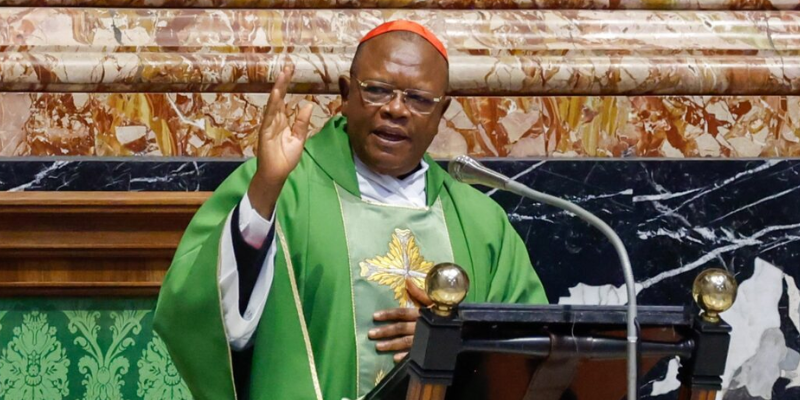
At the center of this vast ecosystem stands Cardinal Fridolin Ambongo, President of the Symposium of Episcopal Conferences of Africa and Madagascar (SECAM), widely regarded as the de facto leader of the Catholic Church across Africa. From his base in Kinshasa, he oversees a footprint that includes 84,689 educational institutions and nearly 14,000 hospitals and social care facilities, giving the Church unmatched reach into daily life and community resilience.
For a continent where stability, skills development, and health access remain core growth drivers, Ambongo’s leadership influences outcomes far beyond doctrine.
Leading the Church Where Growth Is Accelerating
Africa remains the fastest-growing region for Catholicism, at a time when Christianity’s influence has weakened in parts of the world. The numbers reflect a major shift in global religious power: Catholics in Africa rose from 272 million in 2022 to 281 million in 2023, highlighting the Church’s rising weight on the continent.
This is not simply an increase in church membership. It signals a larger development reality: the Church’s institutions are expanding alongside population growth, urbanisation, and rising demand for education and care systems.
In business terms, it is growth at scale, with deep community penetration and institutional loyalty.
Kinshasa: A Strategic Seat of Influence
Ambongo leads from the Archdiocese of Kinshasa, one of Africa’s most influential Catholic centers. Kinshasa itself is a critical city in Africa’s geopolitical and economic map, and the archdiocese plays a decisive role in shaping civic voice, social direction, and moral leadership.
Ambongo’s position gives him both spiritual authority and public influence, especially in a region where religious trust often surpasses political trust in moments of tension.
A Seat at the Top Table of Global Catholic Governance
Since 2020, Cardinal Ambongo has held one of the most strategic roles in global Catholic decision-making: he is an African member of the Pope’s Council of Cardinals, commonly known as the C9, which advises the Pope on governance and Church reform.
This role matters because it places him inside the Church’s highest-level planning and oversight system. It also reflects a broader reality: Africa is no longer at the margins of Catholic governance. It is increasingly shaping the direction of global Catholicism from within.
Papabile: The Rising Global Profile of African Catholic Leadership
Ambongo is frequently described as papabile, meaning a cardinal considered to have the standing and credibility to become Pope. This is not celebrity speculation. It is a marker of global influence.
With Africa’s Catholic population expanding and its social mission becoming more consequential, global Catholicism is watching African leadership more seriously than ever. Recent global reporting on potential future papal leadership has repeatedly included Ambongo among notable figures, reinforcing his international stature.
SECAM Leadership: Coordinating a Continental Church
As SECAM President, Ambongo’s responsibility is continental coordination: guiding doctrine, shaping public engagement, and strengthening unity among Catholic leadership across Africa and Madagascar.
SECAM’s work has also gained visibility through major continental gatherings and strategic direction-setting, including discussions around long-term pastoral visions for Africa’s future.
This is leadership that resembles multi-market governance: diverse countries, different social realities, varied economic constraints, and one shared institution expected to deliver stability, values, and practical impact.
What This Leadership Means Beyond Religion
Ambongo’s influence stands out because the Church’s footprint touches sectors that define national development:
- Education systems that build skills and workforce readiness
- Healthcare and social care delivery that protects productivity and quality of life
- Community stability during conflict, displacement, and poverty pressures
- Public trust and ethics, shaping civic participation and accountability
In regions where state capacity is uneven, the Church functions as a continuity institution. That continuity becomes a form of societal risk management.
From a business lens, any institution that shapes human capital, health outcomes, and social cohesion has long-term economic significance.
A Defining Year of Steady, High-Impact Leadership
Over the past year, Ambongo has stood out for steady leadership at a time when the African Church is expanding in both numbers and influence. His role in global governance, his authority within SECAM, and his position in one of Africa’s most powerful archdioceses place him in a category few leaders occupy.
He represents Africa’s rising intellectual and moral weight inside global Catholicism, at a moment when the continent’s voice is increasingly shaping the future of one of the world’s most influential institutions.
In a world searching for credible leadership that combines values with real-world service delivery, Cardinal Fridolin Ambongo is emerging as one of Africa’s most consequential figures on the global stage.