
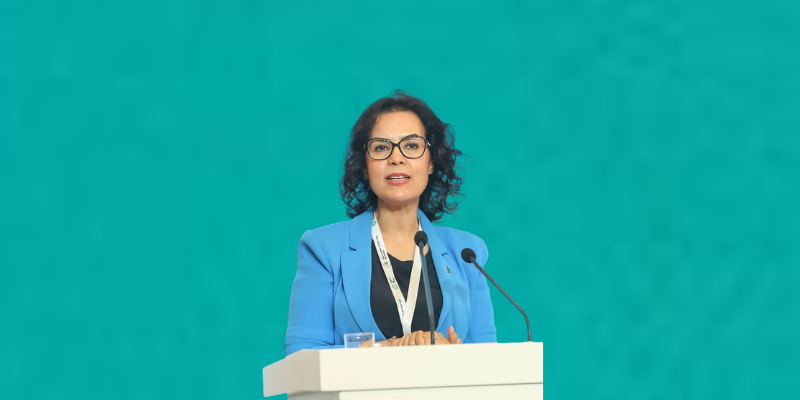
When Dr. Ismahane Elouafi stepped into her role as Executive Managing Director of CGIAR in 2023, it was not just another leadership appointment in the global development space. It was a clear signal that the world’s largest agrifood research partnership was placing science, climate resilience, and farmer-first innovation at the centre of its strategy.
And in 2025, that message became global news. TIME named Elouafi to the TIME100 list of the world’s most influential people. Bill Gates, who profiled her, wrote that she holds “the keys to feeding our future” in a world facing rising food insecurity.
Her story is about leadership, long-term risk planning, and how science-backed decisions can shape markets, livelihoods, and national stability.
Leading a Global Research Engine With Real-World Pressure
CGIAR is one of the most influential forces in agrifood research globally, operating across regions where climate threats are no longer theoretical. Elouafi took charge as Executive Managing Director effective December 1, 2023, at a time when food systems are under pressure from droughts, degraded land, unstable supply chains, and geopolitical disruptions.
Her work sits at a critical intersection: she leads research that must perform not just in laboratories, but on farms where failure has real human cost.
This is where her leadership stands out. Elouafi has consistently focused on building agriculture that works in the world’s toughest conditions, including saline soils and marginal lands, where traditional crops struggle to survive.
Biosaline Agriculture: Turning “Unusable” Land Into Opportunity
Elouafi is widely recognized for her pioneering work in biosaline agriculture, a field focused on cultivating crops in saline conditions using salt-tolerant varieties and adapted farming practices.
In many regions, salinity is a slow-moving crisis. Irrigation mismanagement, rising sea levels, and declining soil health are making once-fertile areas harder to farm. For governments, it becomes an economic issue. For businesses, it becomes a sourcing and supply chain issue. For farmers, it becomes survival.
Elouafi’s career has been built around one question: how do you grow food where the odds are stacked against you?
Her answer has always been practical. Make agriculture resilient where it matters most, not only where it is easiest.
Crop Diversification: A Smarter Food Security Strategy
One of Elouafi’s strongest contributions has been pushing the global agriculture conversation beyond a handful of staple crops. She has championed diversification and the use of underutilised crops to strengthen food security and nutrition, especially in arid and climate-stressed regions.
This matters for both policy and business. Over-reliance on a small number of crops increases systemic risk, from price volatility to nutritional gaps and climate-driven yield failures.
In 2019, Elouafi summed up the urgency with direct clarity: food production is dominated by too few staples, and diversification is essential for health, sustainability, and climate readiness.
For leaders watching long-term market stability, this is not just a sustainability agenda. It is a resilience strategy.
From ICBA to the UN: Building Credibility Across Systems
Before CGIAR, Elouafi served as Director General of the International Center for Biosaline Agriculture (ICBA), where she worked at the frontlines of arid agriculture and innovation.
Later, she became Chief Scientist at the Food and Agriculture Organization of the United Nations, placing her inside the world’s most influential food policy ecosystem.
These roles gave her rare credibility across research, field implementation, and global governance, a combination that is difficult to build and even harder to lead with.
Why Global Leaders Are Paying Attention
Elouafi’s TIME100 recognition is not celebrity influence. It is impact influence.
Gates described meeting her on her first day and being struck by her brilliance and passion, noting her ability to understand farmer realities in regions like sub-Saharan Africa and South Asia.
In a world where food shocks can trigger inflation, migration, and political instability, the people shaping agrifood innovation are shaping global economic resilience.
That is exactly why Elouafi’s rise matters to boardrooms, policymakers, investors, and institutions funding climate adaptation at scale.
The Business Lesson in Her Leadership
Elouafi’s journey carries a leadership message many industries can learn from:
- She builds solutions for high-risk environments instead of ideal conditions
- She focuses on systems, not quick fixes
- She champions diversification as a hedge against uncertainty
- She proves that science leadership can move markets and protect lives
At CGIAR, she is not simply managing research. She is guiding a mission that touches billions of people through food availability, nutrition, and farming livelihoods.
Credentials That Match the Responsibility
Elouafi holds an MSc in Plant Breeding from Morocco’s Hassan II Institute of Agronomy and Veterinary Medicine and a PhD in Genetics from the University of Córdoba in Spain. She also received executive education from INSEAD and is fluent in Arabic, French, English, and Spanish.
This blend of scientific depth and executive capability is a key reason she has become one of the most trusted voices in global food systems leadership.
A Future Built on Resilience, Not Hope
Food security is no longer a niche development concern. It is a strategic priority tied to economic performance, public health, and climate survival.
Dr. Ismahane Elouafi represents a new generation of global leadership: deeply technical, highly strategic, and relentlessly grounded in real-world outcomes.
When TIME called her one of the world’s most influential people, it was not a headline. It was a warning and a roadmap at the same time.
And under her leadership, CGIAR’s mission becomes even clearer: the future of food will not be saved by business-as-usual farming. It will be built by science, diversification, and decisions made early enough to matter.