
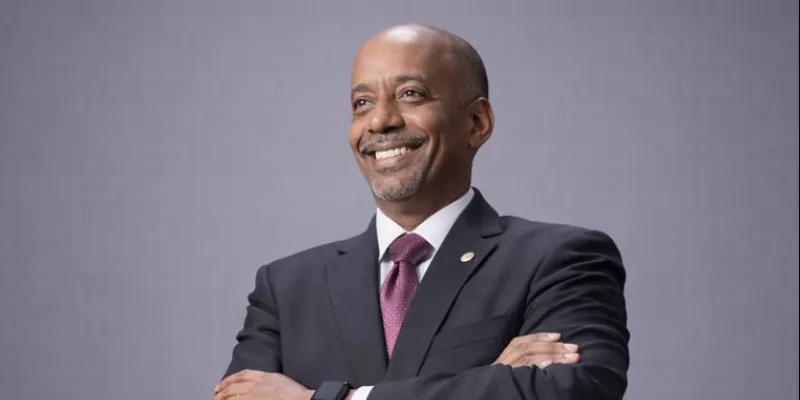
Admassu Tadesse has built a reputation not simply as a banker, but as one of the most disciplined strategic minds in global development finance. As Group President and Managing Director of TDB Group, he operates at the center of conversations that determine whether African economies merely cope, or compete.
His vantage point is unique. He sees how debt stress, volatile capital flows, and rigid global rules collide with the realities of building infrastructure, powering industries, and financing growth across emerging markets. Where others debate around the margins, Tadesse presses for something deeper. Structural reform. Clearer incentives. Capital systems that recognize development as an investment, not a concession.
Rewriting the Rules of Development Finance
Here is what sets Tadesse apart. He understands both the logic of markets and the demands of public purpose. That rare combination has made him a persuasive voice in boardrooms, policy circles, and sovereign advisory rooms.
He argues that African institutions are asked to achieve impact while operating inside frameworks that penalize exactly what development requires: patience, risk tolerance, and scale. Regional development banks are expected to mobilize transformative capital, yet are governed by rules that treat ambition as risk rather than opportunity.
To Tadesse, that contradiction is unsustainable.
He believes the world’s financial architecture needs a recalibration. Better coordinated regional development banks. More intelligent leverage of existing balance sheets. Capital adequacy rules that recognize the difference between speculation and long-horizon development financing. And tools that reward impact while preserving discipline.
This is not ideology. It is math. It is governance. It is strategy built on observing, repeatedly, how outdated financial assumptions slow down economies that should be accelerating.
A New Narrative on African Capital
One of Tadesse’s most compelling arguments challenges a deeply rooted misconception: that Africa’s finance gap is purely external.
“We must reject the myth that capital scarcity is purely an external problem,” he says. “Africa’s own savings, pension funds, and remittances, much of which sit idle or are channelled abroad, can be better harnessed with the right vehicles.”
It is not just a statement. It is a reframing of power. If domestic capital can be mobilized effectively, African economies become less vulnerable to cycles of global liquidity. They gain negotiating leverage. They design financial products built for local priorities, not imported templates.
For investors, that shift also changes the risk story. The continent becomes not only a destination for capital, but a co-creator of its own financing instruments.
Why Africa Is No Longer the Periphery
Tadesse is unapologetic about Africa’s strategic relevance.
He points to critical minerals at the heart of the energy transition. To demographic momentum that can power labor, consumption, and innovation. To food production potential that will influence global food security. To clean energy ecosystems that, if scaled properly, could leapfrog legacy systems.
“Africa has solutions to many of the world’s strategic challenges,” he argues. “We must make the case, boldly and credibly, that investing in Africa is not charity. It is smart economics.”
This is where his leadership resonates with investors and policymakers alike. He is not selling hope. He is outlining value creation.
Debt, Discipline, and Development Reality
Debt restructuring remains one of the thorniest issues in development finance. Tadesse does not sugarcoat the problem. But he also challenges simplistic narratives.
He knows countries cannot grow under the weight of unsustainable obligations. Yet he also recognizes that blanket austerity kills the very industries required to repay debt. His approach focuses on restructuring frameworks that preserve credibility while protecting investment capacity.
It is a delicate balance: maintain discipline, avoid moral hazard, and still create room for governments to build.
Few leaders manage that conversation with his level of clarity.
Building an Ecosystem, Not Just a Bank
Under Tadesse, TDB Group has expanded beyond traditional lending into trade finance, asset management, and partnerships designed to crowd in private capital. The philosophy is intentional. A single institution cannot move the continent. An ecosystem can.
That ecosystem relies on three ideas:
- Smarter capital that blends public funding with private investment in commercially viable projects.
- Regional coordination that prevents duplication and amplifies impact.
- Financial innovation that reduces risk perception without distorting markets.
In practice, this means structuring transactions that prove scale is possible, showing global investors that returns in Africa can be both competitive and responsible.
Leadership With Conviction
What makes Admassu Tadesse compelling on a global stage is not volume. It is consistency. He articulates Africa’s case with confidence grounded in numbers, experience, and results.
He is clear about what must change. He is equally clear about what must remain: prudence, accountability, and high performance standards inside African financial institutions.
Because credibility is currency. And he knows Africa cannot afford to squander it.
The Future He Is Betting On
Tadesse’s endgame is simple to describe and difficult to achieve. He wants a financial system in which African capital works harder inside Africa. Where institutional investors do not automatically look abroad first. Where development banks are judged not only by capital ratios, but by the prosperity they help unlock.
He is not advocating for isolation. He is arguing for parity, partnership, and respect built on competence.
In a global economy recalibrating after shocks, debt crises, and geopolitical realignments, his message is gaining traction. Investors want diversification. Governments want stability. Banks want credible structures. Tadesse sits at the intersection, pushing each stakeholder toward a more realistic, more balanced path.
And in doing so, he is shaping how the continent finances its future. Not with rhetoric. With systems. With strategy. With a vision that says Africa is not waiting for permission to grow. It is designing the financial tools to make that growth inevitable.